Generating Desirable Difficulty – Using AI When the Messy Path Matters
Everyone – including the Pope – is talking about AI. It came up most recently for me in my artist group where we were discussing using AI to help create an artist statement. These statements are notoriously angst-producing – yet they are required for galleries, applications and portfolios. There is so much that needs to be conveyed in such a short amount of space – the concepts and motivations behind your artwork, what and how you create, a sense of who you are as an artist. And on top of all that, you must also demonstrate that you are doing interesting and authentic work.
It is a lot to pack in. And for many artists – most of whom would rather be in the studio and some of whom struggle with words as a medium – off-loading the cognitive effort onto AI is a welcome shortcut.
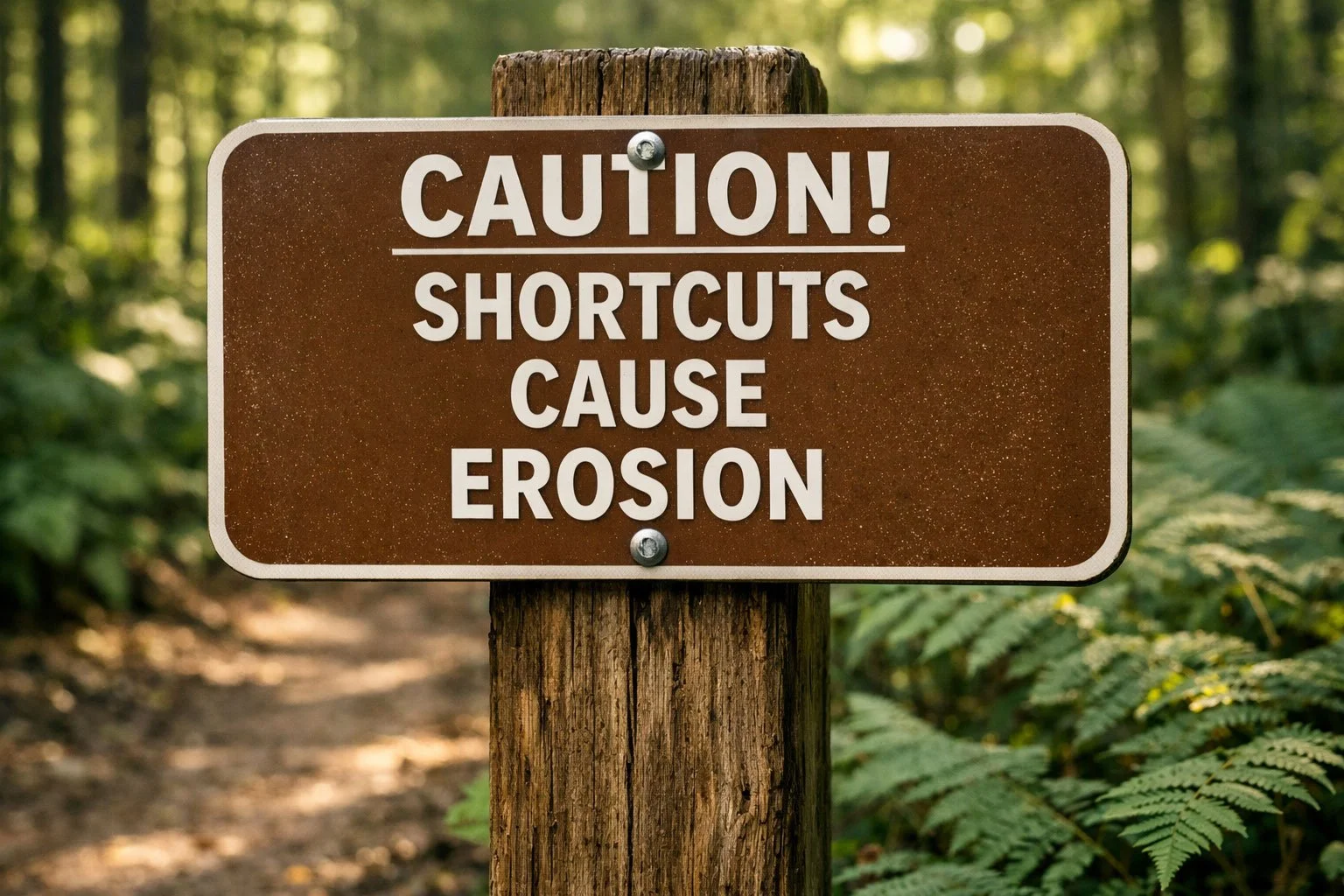
Image generated in collaboration with Copilot.
There is nothing inherently wrong with a shortcut. In fact, leaning on cognitive shortcuts has been a brilliant evolutionary strategy for making the most of our small brains in a big world. But those shortcuts have been successful precisely because they developed in a place and time that was never going to let us become complacent. The brain was always going to work to learn things the hard way because it often had no choice. We were always going to struggle with messy thoughts and unpolished ideas because that was often the only path to clarity.
Enter AI and the promise of an endless buffet of knowledge and polished products for minimal cognitive effort. It is a siren song for our brains. But should we succumb?
This is not an anti-AI post. It is a cautionary post – a “yes, maybe, but” perspective for people who use AI but want to do so in a way that augments rather than shortcuts their own learning and creative process.
The good pain of a struggling brain
One of the reasons I love to create art is that it helps me explore messy feelings and half-baked ideas and wrestle them – at least momentarily – into the clarity of a tangible reality. It is rarely an easy process and I am constantly wishing for a shortcut even as I know that the finished work only ever emerges through the struggle itself.
My art process is an example of what psychologists Elizabeth and Robert Bjork call “desirable difficulty.” Their research shows that when learning requires more cognitive effort, it may slow down in the short term but it ends up significantly better in the long term. For example, making your brain search for or struggle with information rather than simply asking it to recognize or to pay attention is more likely to make that information stick.
This is because actively processing information – which can feel like digesting, exploring, playing, or struggling with ideas and skills – changes your brain at a fundamental level. It creates and fortifies neural pathways, connects disparate pieces of knowledge into cohesive structures, and helps messy and uncertain thoughts mature into reliable and intuitive mental models.
The process can feel hard, uncomfortable, or even vaguely painful – much like lifting weights at the gym – but it is a necessary part of building our cognitive muscles. There are ways to support the process but there are no real shortcuts. No one can give you a mental model, you must build it yourself.
And yet hope springs eternal. A short prompt and a click of a button will yield a seemingly polished and sophisticated artist statement. This is probably fine if you are turning to AI for wordsmithing after finishing the heavy cognitive lifting of wrestling with what your work means. But I have always found that the very process of having to put my work into words is what triggers deeper thinking.
Without the “desirable difficulty” of this process, the sense of competence and coherence that an AI-generated statement might give me would be but an illusion. It wouldn’t take much – a probing question from a curator or collector for instance – for me to realize that I lack the meaningful mental models that would allow me to talk about my work with fluency.
AI proponents will tell you that these problems stem from viewing AI as an “answer giver” rather than a “thought partner.” And that when used more intentionally, the power of AI can be harnessed to help us actually build those mental models.
This makes me wonder what kind of partner we are getting in our thought partner. Is it the kind that brings out our best by helping us unearth ideas and build understanding? Or is it the kind of partner we’ve probably all run up against in group projects who actually makes it harder to do something worthwhile?
Who is your partner?
Many people think of generative AI as wise and thoughtful. But the reality is that your thought partner is basically a highly advanced, statistical autocomplete machine that learns and extracts language patterns from massive – yet imperfect – datasets. For all its power your partner has some major limitations simply due to the data on which it has been trained. But the problems don’t stop there.
Another obvious problem is the tendency of your AI partner to hallucinate – to blatantly make stuff up and present it as fact.
And then there are the limitations that don’t get as much attention but are just as problematic.
These are some that I find particularly detrimental and annoying:
Your partner fixates too early. You have probably heard about anchoring bias – the tendency of people to rely too heavily on the first piece of information they receive when making a judgement or decision. It turns out that AI also suffers from anchoring bias. Initial prompts and responses play outsized roles in an AI conversation thread because these early choices mathematically constrain what comes next. This biases AI toward pressuring you to refine a narrow path rather than helping you think expansively.
When human and AI anchoring biases interact, it can start a vicious cycle – we anchor AI with our initial prompt, it further anchors itself with its initial output, this then anchors our subsequent prompts, and so on. The result is a narrowing of the conversation when we should be expanding it. And this is a real creativity killer.
Your partner indiscriminately repeats whatever it has been told. AI tends to amplify already loud ideas and perspectives simply because of the way it works. This means that the topics, opinions, and brands that are the most plentiful in the training data are the most likely to show up in AI responses and recommendations. Similarly, the language patterns that are already the most plentiful will be further amplified. And of course, the ideas and perspectives that are absent or underrepresented in the digital landscapes that AI models roam are unlikely to enter into the conversation.
The AI bias toward amplification can dovetail in a negative way with people’s susceptibility to the availability bias – a cognitive shortcut where we tend to estimate the likelihood and veracity of something based on how easily examples of it spring to mind. So again, we have a potentially negative cycle where AI repeats the most common perspectives and language and we, in turn, become more likely to believe in and repeat those things ourselves.
Your partner suffers from overconfidence. AI models are notoriously overconfident. They consistently present fabricated or incorrect information with the same fluency and absolute certainty as verified facts. And that confidence can rub off on us. When AI tells me that I have made “a massive distinction,” it is implicitly suggesting that I have arrived somewhere when in fact I would be better off continuing to explore. And when it tells me, “Here is a perfectly balanced, 3-part structure that beautifully mirrors your background,” I feel subtly pressured to just go along with its suggestion.
Your partner defaults to flattery. Another big problem with using AI as a thought partner is that it is trained to maximize user satisfaction and so are more likely to agree than to question or provide a different perspective. This further leans into our biases and stifles exploration. The congratulating tone is also just plain annoying. Not everything “makes total sense” or “is an important insight.”
Despite all the problems with AI models, people are still inclined to trust them. This human bias has been found not just for AI but for computers and tech in general. Polished looking answers and products are easy to mistake for competence and authority. When the information goes down easily – in the sense that it does not demand much cognitive processing effort – the brain tends to code the problem as solved and stop engaging.
So, your thought partner has problems – don’t we all?
As I said, I am not an AI hater. In fact, I have found AI extraordinarily helpful for many things – doing complicated information searches, giving me a framework for thinking about what to look for in a new mattress, and reminding me what my main findings were in a long research report that I wrote over ten years ago.
But as helpful as AI can be, I am also increasingly aware of how it can limit and sabotage my efforts to think critically and to build my own understanding.
The trick, for me, is figuring out how to use AI in a way that supports what I am actually trying to do.
Or not.
Because despite the pressure to use it RIGHT NOW unless we want to fall behind, sometimes the best decision is to not use AI at all. My preferred ideation tools are still a journal and a nice pen for writing and a stick of charcoal and paper for studio work.
But when I do turn to AI to help me explore ideas, I am trying to think of it not as an “answer giver” nor even as a “thought partner.” Instead, I am trying to get it to act more as a “desirable difficulty generator” by setting up the conversation so that the AI forces me to think deeply and refrains from giving its own spin unless directly asked.
Lately, I’ve been thinking about my artist group discussion and I am experimenting with how I might use AI to productively help me develop an artist statement for my new body of work.
If you’re interested in seeing how my experiment goes, tune in to my next post.
Related Posts



Muddling may sound like a poor way to make decisions or live a life. But the art of muddling through – in the sense of taking incremental experimental steps based on experience, intuition, and opportunity – can serve us well when journeying through a complex and uncertain world.