Three Simple Art Activities To Get You Seeing More Deeply
One day in fifth grade, I was sent on a quick trip to the school office to collect some supplies for the class. Because I was a responsible kid, the secretary waved me through to the large supply room. Big mistake.
What I found was not the paper I had been sent to get, but the craft supply section – boxes of pipe cleaners, pompoms, tongue depressors and other tactile treasures that my hands simply couldn’t resist. I started to explore – just visually at first – but I was soon sitting cross-legged on the floor ankle deep in little artistic creations. Forty-five minutes later I looked up to find my teacher, Ms. A, whom I adored, looming overhead. “That,” she said, “is the longest five minutes I have ever seen!”
Seeing, as it turned out, was exactly the problem. Because the more I explored and played, the more I saw – art supplies, things that could be art supplies, and endless possibilities for what I could do with it all. And time obligingly did what it tends to do when one is completely absorbed in something – it stopped.
My last post was about what we have to gain when we slow down and observe art more deeply. This post turns that equation around. Because it turns out that making art can be a direct route to slowing time and seeing more.
Want to get making?
Below are three art-making activities that I have been using lately as a way to practice my observation skills and engage more deeply with my environments. I have also used them in workshop settings to warm people up, shift their perspectives, and get them looking beyond the obvious.
1. Texture hunting
Texture hunting is a great way to change how you experience your environment.
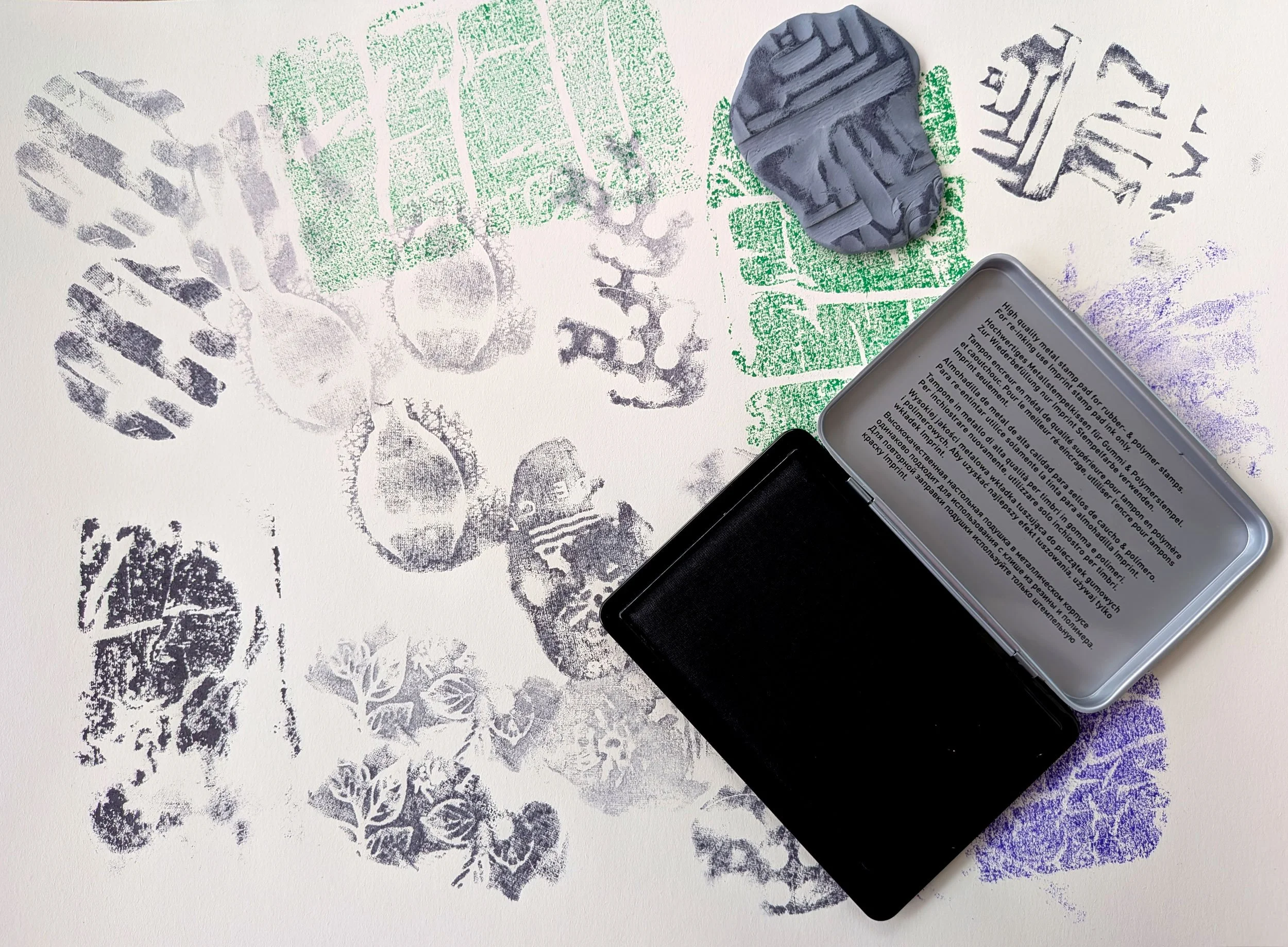
What you do: Rather than moving through your environment looking as usual at objects and landmarks, you move through it looking for texture. When you find something interesting — the grain of weathered wood, the pitting on an old stone wall, the raised lettering on your stapler, the starburst of a pen cap — you capture it. My current favorite method uses a kneadable eraser (Staedtler works well), a stamp pad, and a notebook. The directions are simple: knead and flatten the eraser, press it onto the texture, pat it onto the stamp pad, and print it in your notebook. When you're ready for the next print, knead and flatten the eraser again – no need to wash off the ink although you might want to have some baby wipes handy for your fingers.
What it does: Texture hunting redirects your attention and changes your perspective. Instead of seeing only the things your brain decides are worth noticing when it operates in default mode, this activity forces it to slow down and look beneath the surface — at materiality, at details, at the physical construction of things. In a new city, texture hunting can be an alternative to the guidebook – a way of connecting to the actual fabric of a place rather than its official highlights. In a familiar place, it can make the normally overlooked suddenly interesting.
2. Blind contour drawing
This is a classic art school warm-up exercise — used not to improve drawing skills but to get the eye and hand working together and to shift the brain into a different quality of attention.
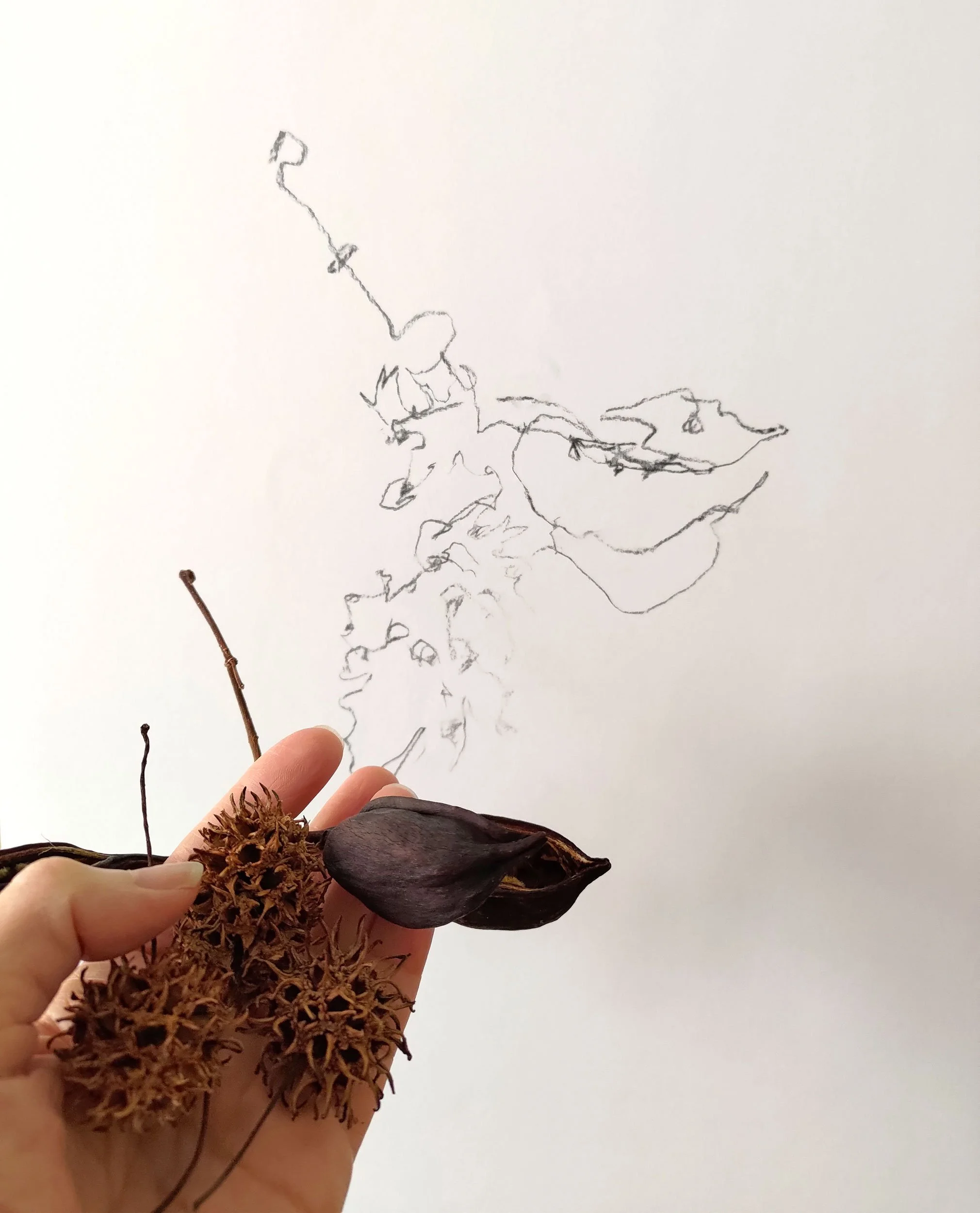
What you do: Grab a pen or pencil and some paper and choose a small, textured object — a leaf, a pinecone, your own hand. Now move your eyes slowly along every edge and contour of the object, moving your pen at exactly the same speed. The two hard and fast rules are that you cannot look at the paper while you are drawing and you cannot lift your pen. You can do the drawing inside a paper bag or under a cloth if peeking is too tempting.
The result will probably look nothing like the object – that is absolutely fine because the value is in the process, not the end product.
What it does: Our brains are very efficient at substituting labels for observation. Asked to draw a leaf, most people produce a recognizable leaf shape — typically a simple outline with smooth edges — not because that’s what any actual leaf looks like but because that is what the brain's image of “generic leaf" looks like. Blind contour drawing short-circuits this substitution of the generic for the specific. When forced to follow the actual edges of the thing in front of you, your brain starts to notice dips, undulations, and irregularities that it would otherwise have smoothed straight over. You stop seeing "leaf" and start seeing the particular leaf in front of you.
Following the no-peeking rule is critical. Because the moment you look at your paper, your brain shifts into evaluation mode — judging the drawing, trying to correct it — and the value of the exercise is lost.
3. Drawing sound
This idea is adapted from a workshop that I took last year with artist Debbie Lyddon.
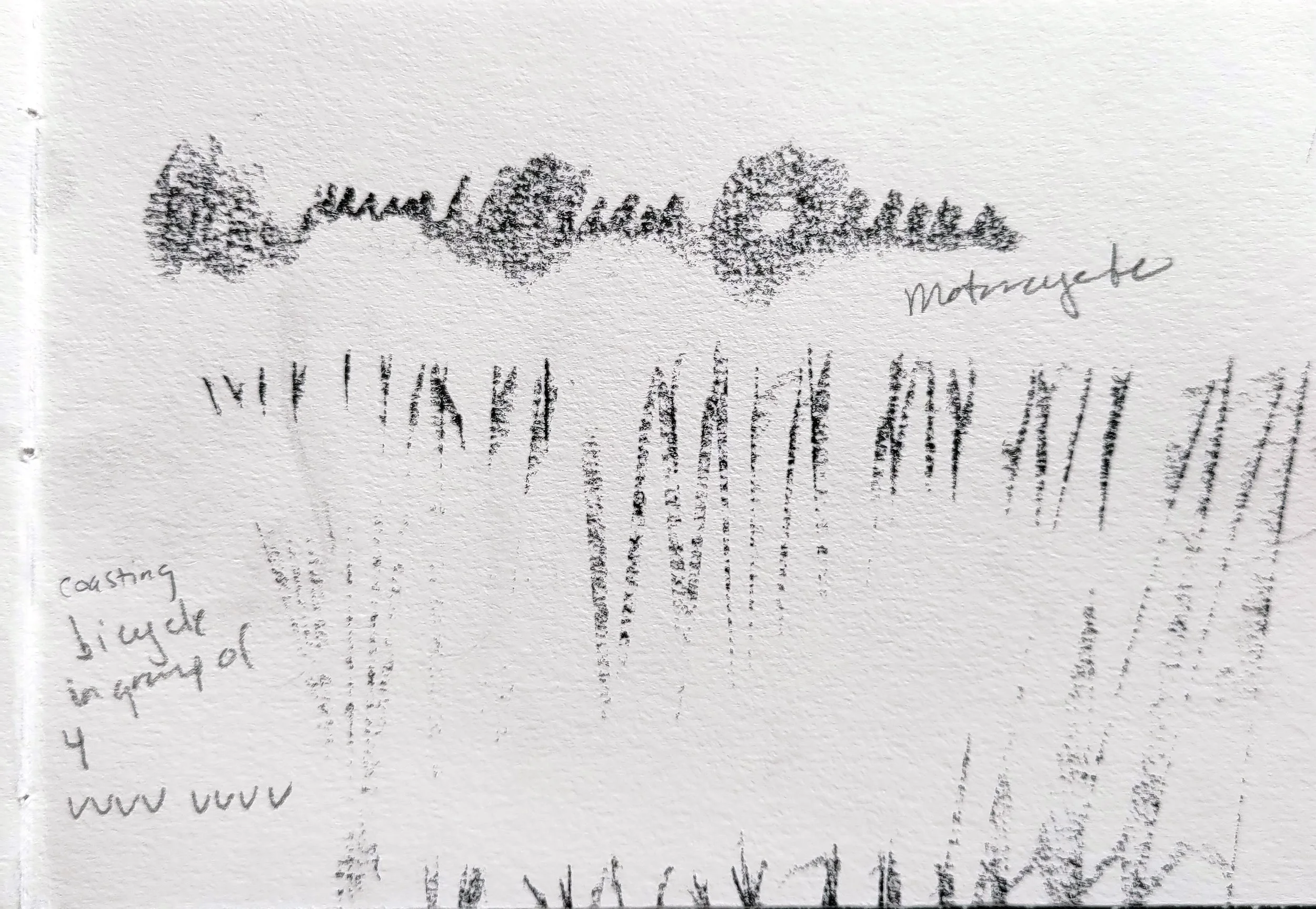
What you do: You will need paper and something to mark with – I enjoy using charcoal or a soft woodless pencil because of the varied marks that they can make, but anything will do. Find somewhere where you can comfortably sit still for a while – a park, a café, a street bench, or anywhere else that interests you. Now close your eyes and simply listen. Notice the quality of the sounds around you. A sharp bird call. The low, sustained hum of an airplane. A burst of laughter. The rhythmic clicking of bicycle spokes. Now try and translate what you hear into marks on the paper. You are not drawing symbols or pictures of the things you hear. You are making marks that capture the quality of the sound itself – its sharpness or softness, its heaviness or lightness, its rhythm, the way it moves through space or time.
You might also try capturing a soundscape rather than individual sounds by using a longer strip of paper and letting your pencil respond continuously to whatever you hear.
What it does: This activity is more challenging than the other two because it forces a perceptual translation — you are no longer simply looking, you are observing through a completely different sense and then translating that into a visual form. I have found that this activity grounds me deeply in the moment and heightens my senses. I once spent thirty minutes doing this in a little plaça in Barcelona and came away astonished to have realized just how much my brain routinely filters out.
Taking it to a group
Any of these activities could be used in a group setting — a workshop, a team offsite, or simply a gathering of curious people.
I recently used texture hunting as a warm-up for a discussion on how our environments affect our health and behavior. We were in an unpromising conference room, and I wasn't sure how it would go. But people surprised me — exclaiming over pen caps, chair backs, the grill of a heating vent – and everyone ended up in an open, playful, slightly ink-stained frame of mind. And as one participant noted, it made her much more aware of her environment – a perfect segue into further discussion.
It’s not about the art
None of these art-making activities are really about the art. They are about the process of art-making and how it can get your brain to slow down, pivot, and observe with a fresh perspective.
So try something. Take a kneadable eraser on your next walk or listen to sounds with a pencil in hand. You don’t have to be an artist or even to believe that you have any artistic talent to start noticing what you’ve been missing.
Related Posts



Six strategies for maximizing your online art experience.