On Getting Lost and Getting Things Done
I’ve been thinking lately about the difference between meaningful exploration and wasting time and how difficult it is, in the middle of either one, to know which I am doing.
Spending three hours researching toasters before making a decision? In retrospect, a waste of time. Spending eighteen months exploring a myriad of techniques, materials, and ideas in my art studio without producing a single finished painting? Less clear.
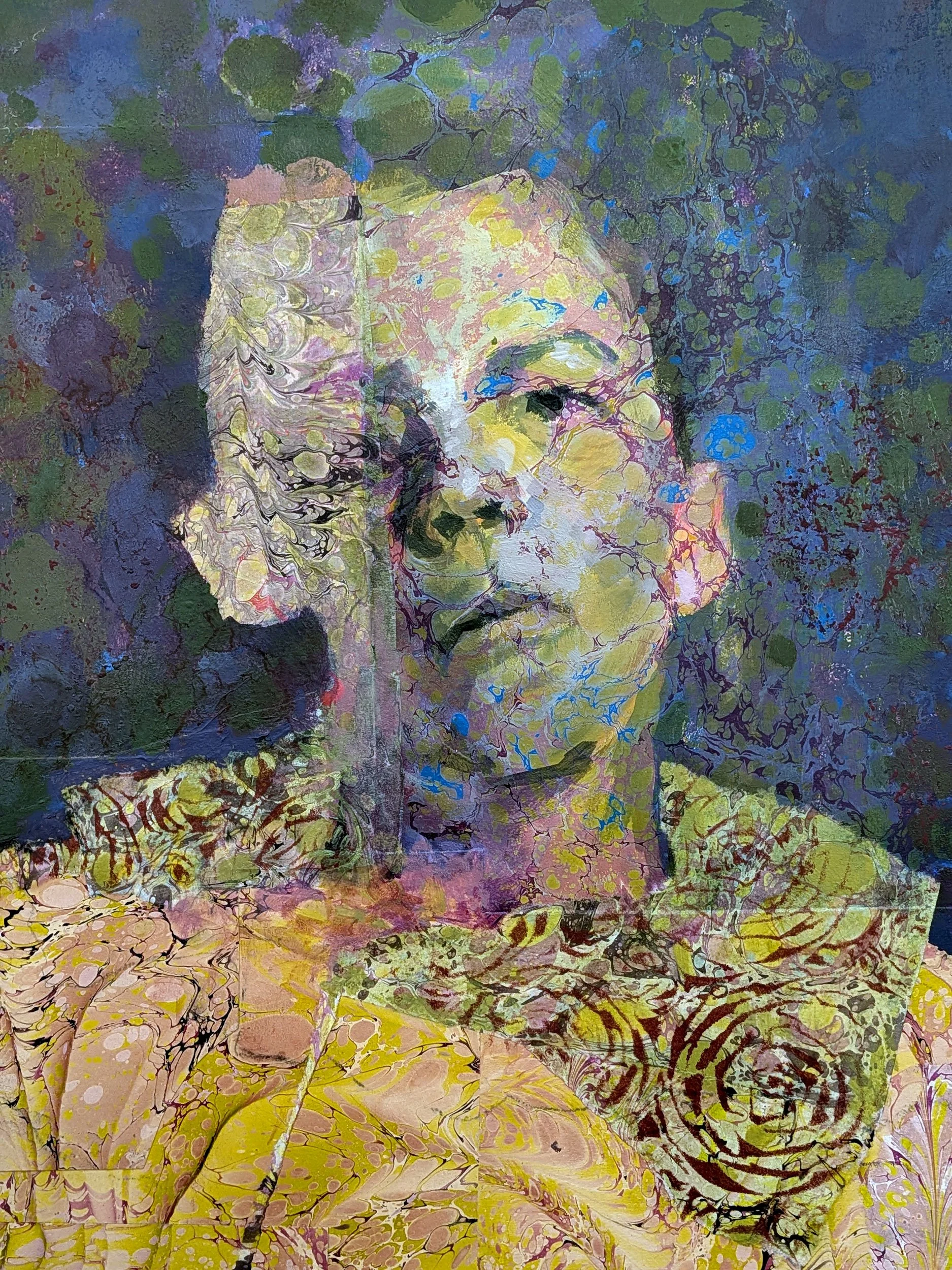
Detail of a painting that feels almost finished after a painfully long time in exploration mode
I was recently at a Q & A with Alex Kanevsky, an artist whose work I very much admire. He surprised me by saying that he doesn’t really spend time exploring new materials and techniques. Why? Because every new thing has a learning curve and could end up leading into a blind alley – in other words, from his perspective a waste of time. He would rather, he said, stay with what he knows and focus on continuing to refine his skills.
Kanevsky is a very successful artist and I could see many people making a note to “go deep, not broad.” But although this strategy has clearly worked for him, I know just as clearly that it would not work for me. Exploration is the foundation of my art practice – both in terms of how I develop my work and also in terms of what draws me to art in the first place. If I were to set exploration aside to focus on capitalizing on what I already know, I would probably end up with more finished paintings but would definitely be less satisfied.
And yet, I look at Kanevsky’s focus and purpose with a tinge of envy. Because if I am honest, I see that while exploration can lead me forward, favoring it can also hold me back as it leads me down a labyrinth of dead ends or tips me into procrastination.
I can’t help but think that there is a balance that is eluding me. A way to more competently navigate the tension between a passion for experimentation and a desire to get things done. A way to glide along the edge between discovery and familiarity, not having to choose between breadth and depth, as I get to eat my curiosity cake and have my finished paintings too.
What exactly is my problem?
Economists have a name for the tension between free exploration and going deep – they call it the “exploration-exploitation trade-off.” Given limited time and resources, when do you stop sampling unknown options and commit to the best one you've found? The answer they have come up with, after a whole lot of math and modeling, boils down to this: keep exploring until the cost of not committing outweighs the value of what you might still discover.
This framework, and the optimization algorithms that underlie it, may be useful if you are drilling for oil or running a clinical trial. But less so if you are trying to decide whether to keep going with your current painting series or start exploring something new. The problem is that the assumptions economists make – that the goal is fixed, payoffs are easily measurable, and exploration itself has no intrinsic value beyond what it yields – simply aren’t true in much of life. They are certainly not true for artists.
Psychologists offer a more realistic picture. They frame exploration and exploitation not as parts of a strategy to be optimized but as competing human drives with deep evolutionary roots. Tension is created by a mind that is curious but also finds comfort in the familiar. That gets a dopamine hit from the thrill of sailing in uncharted waters but also deep satisfaction from skillfully operating within familiar territory.
From this perspective, our competing drives are not trade-offs but rather a synchronized way of helping us be at our best in a complex world – whether in the studio or beyond. The restlessness that keeps me exploring is what drives my work forward. The desire to use what I know to go deeper is what helps me build mastery and ultimately leads to finished paintings.
The question isn’t how to resolve the tension between the new and the familiar, but how to live inside this tension in a way that supports what we want to be doing.
And that brings me back to the question of balance.
The false promise of tidy solutions
The economic model has given rise to some tidy solutions for how to strike a balance between exploration and exploitation, many of which have been enthusiastically endorsed by productivity gurus. They tell us to spend a certain percentage of our time on exploration and the rest on applying what we already know. We may be encouraged to adjust this ratio to favor exploration early on and application as deadlines approach. Some organizations have formalized this ratio approach — allocating a day a week or, more abstractly, “10% of your time,” to exploration in the hope that structured play will lead to innovation.
In the context of an organization, this approach may well be helpful and I certainly understand its appeal. Yet I am skeptical that creative work readily submits to this kind of compartmentalization. I am fairly certain that my own creative work does not. Exploration and production are not always separate phases that can be assigned to different calendar slots. An arbitrary allocation of time might not fit the needs of the moment.
And what the focus on productivity misses entirely is that exploration itself is often the point, not just a means to an end. The engagement and pleasure that come from the journey into the unknown can bolster personal and work satisfaction without showing up in measurable productivity or the bottom line.
What about untidy solutions?
If tidy prescriptive solutions for navigating the tension between exploration and application don’t work in the messy non-optimized real life of creative practice, what might?
For me, the best approach is less about time and resource management and more about developing a kind of ongoing self-awareness — noticing which drive is running the show at any given moment, and asking whether it is serving the work.
In my efforts to make sure that exploration does not turn into procrastination and that focus and productivity do not turn into creative stagnation, I am trying to:
Learn to read the signals
I am cultivating a more explicit practice of reflection. I try to reflect on what I’ve done at the end of the studio day and how it felt. And I try to do deeper monthly reflections on how the work is going. I am giving myself time to follow ideas that are seemingly going nowhere but that resist being put down, that I find myself returning to, that in some cases fill my dreams with unresolved angst. And on the other hand, I am paying attention to feelings of restlessness with exploration, to the niggling suspicion that continuing to try new things is becoming a way of avoiding the harder work of going deeper.
Wait to commit but commit before I’m ready
I try to be attuned to the pull of well-worn ruts and resist them, at least in the early stages of new work. Favoring exploration and play is a way to protect new and vulnerable ideas from familiarity and premature judgement. On other hand – and this is definitely harder for me – I am pushing myself to commit to starting the deeper work before I feel ready, knowing that figuring out what I am doing can only be done through the work itself.
Be willing to be wrong
Creative work is really a series of small experiments, many of which don’t pan out. This means that committing to an idea that ultimately – or at least for the time being – doesn’t lead anywhere is not a failure. It is an important and unavoidable part of the creative process. But that doesn’t mean that letting go of ideas that we’ve spent time and energy on is easy. I am working on being more zen-like. Not giving up too easily, but also not continuing to bang my head against the wall.
Show up regardless
The most consistent advice from artists who have managed to sustain their practices is to show up consistently, whatever that means for you. I know that waiting to feel inspired to experiment or to get down to work is a trap. Showing up – in the studio space and in my mind – is what creates the conditions for both. And the decision about which mode to be in often becomes clearer once I am in the room.
Finding a new kind of clarity
Writing this post has helped clarify my own thinking around experimentation versus getting things done. And my main realization is that the clarity I was looking for – a magic ratio, an optimal balance – doesn’t exist. Kanevsky’s answer is right for Kanevsky. Mine will be different and changeable.
What I have gained is a greater awareness of the tension itself and a growing capacity to gently steer my practice from one way of working to another. Reflection is helping me notice when exploration has become a way of hiding. When the self-imposed pressure to produce has started to squeeze the life out of the work. When the feeling of being haunted by something unfinished is a signal to chase that idea into the unknown. And when hitting the wall one too many times is a signal to let it go.
The real magic, it turns out, lies not in the balance but in the search – the reflection, the many adjustments, and even the feeling of never quite arriving.
Related Posts