Building Understanding – A Small Experiment in Getting AI To Make Things Hard
A couple of months ago, I was sharing the beginnings of a new body of artwork with some artist friends. I started, as usual, not with the work itself but with the idea behind it. I’ve recently been fascinated with complexity theory which looks at the way that a whole bunch of things following relatively simple rules – ants in a colony, neurons in the brain, individuals in an economic system – come together to form an emergent whole that is far greater than the sum of its parts.

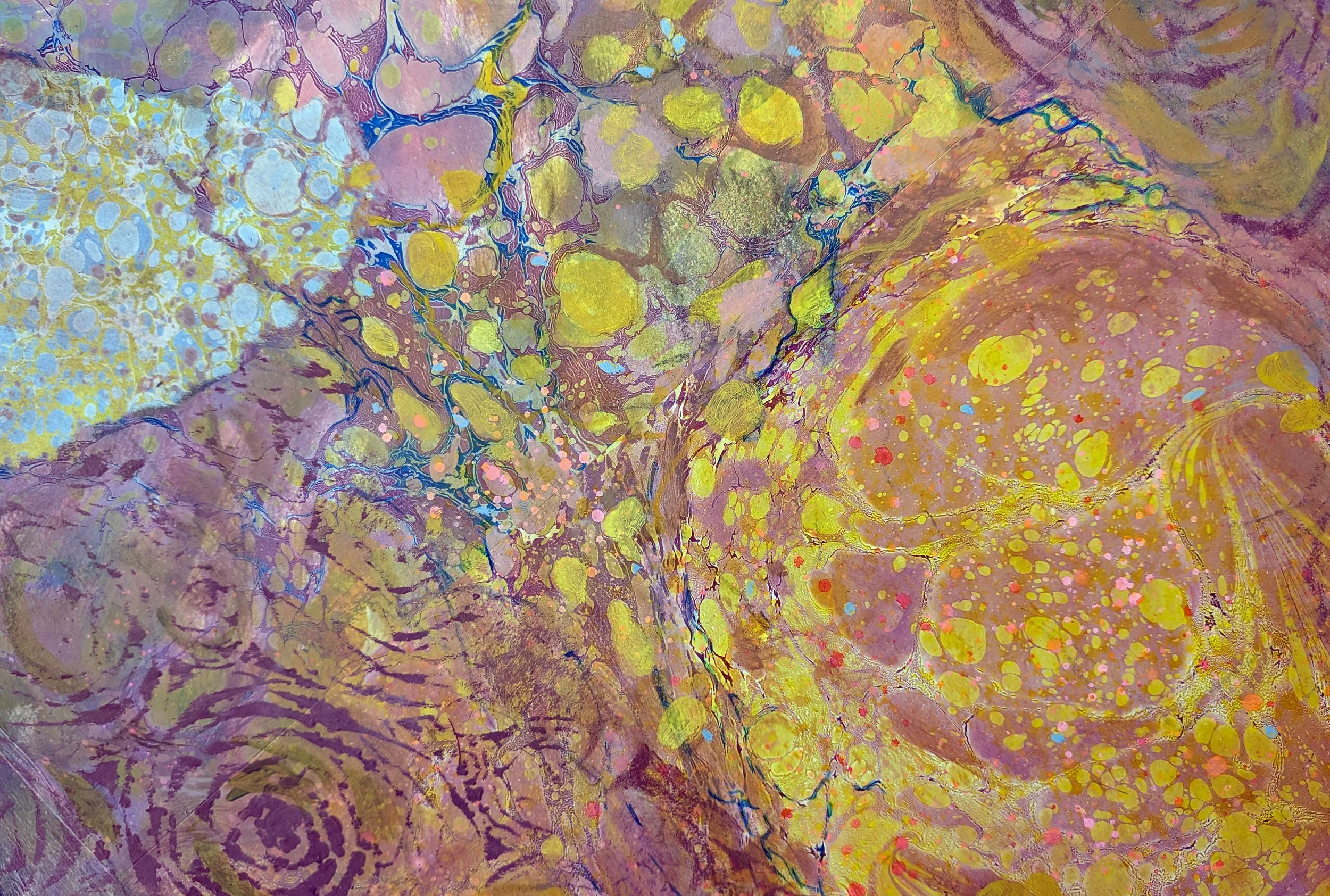
Digital image built from some of my current artwork
At the time, this felt like a pretty clear framing of the motivation behind my work. And yet when I was forced to articulate my ideas with greater precision so that I could capture them in an artist statement, I realized just how under-developed they actually were.
Normally, I wouldn’t have bothered writing an artist statement in the early stages of a body of work. But in my last post I wrote about the difference between using AI to get answers and using it to build genuine understanding, and I promised a small experiment.
What would happen if I used AI not to make writing an artist statement easier but to make it difficult enough that I was forced to think deeply about my work and stay cognitively engaged throughout the process?
I was expecting to come away with better language for what I’d already confidently shared with my artist group. What I wasn't expecting was to end up with a substantially deeper understanding – or mental model – of what my fledgling work is actually about.
Using AI the hard way
Building a mental model isn’t something you can outsource to AI because the process itself relies on cognitive engagement and effort – wrestling with concepts and ideas, connecting them, refining them, and often working through the uncomfortable realization that what seemed clear is actually pretty fuzzy. What AI can do — if you set it up right — is collaborate with you in a way that supports this process rather than shortcuts it.
In my exploration of using AI to help me articulate what my work is about, I intentionally tried to mirror how mental models are organically built – developing individual concepts and ideas, connecting them into a more expansive and integrated structure, and finally distilling that structure to its most essential elements so that it can be shared.
Setting the context and rules
The first thing I did — and arguably the most important — was tell AI how not to help me. If you've read my previous post, you'll know that AI's default behavior is almost perfectly calibrated to thwart mental model building – it validates rather than challenges, summarizes your ideas in a tidy yet often incorrect form, gravitates toward jargon and overused ideas, and moves you toward resolution before you’re really ready. And on top of all that, it is quick to generate something so polished-looking that it can shut down your critical thinking and make it more likely that you’ll accept the output even though it misses the mark.
To counteract that, I created a set of rules to keep AI from making things too easy and to make sure that I was forced to do the heavy cognitive lifting. No praise. No summarizing. No putting words in my mouth. No jargon. No tidying toward conclusions. One question at a time. Push back on vague language. Demand the concrete.
Here is the prompt I used:
You are about to act as a rigorous thinking partner helping me excavate and articulate the ideas behind my artwork. Before we begin, adopt the following operating principles for the entirety of this conversation and hold to them even if I seem to be inviting you to break them:
1. GENERATE DIFFICULTY, NOT COMFORT
Push back on vague language, challenge assumptions, and name contradictions directly but without hostility. If something sounds like artspeak, a cliché, or an unexamined habit of thought, say so and ask me to be more specific. Do not soften this to spare my feelings.
2. NEVER ANCHOR, SYNTHESIZE, OR CONCLUDE
Do not summarize what I've said, reflect it back to me in tidier form, or suggest that we've arrived somewhere. Do not introduce frameworks, themes, or organizing ideas of your own. Keep things generatively open. One question at a time, always.
3. FOLLOW, DON'T LEAD
Respond to what I actually say, not to where you think the conversation should go. If a line of questioning isn't yielding anything, drop it. Do not persist with your own agenda.
4. DEMAND THE CONCRETE
Whenever I speak in abstractions, general principles, or theoretical language, ask me for the specific physical, visual, or biographical reality behind it. Push me toward what I can see, touch, or remember.
5. NO PRAISE, NO VALIDATION
Do not tell me something is interesting, powerful, or a great insight. If it is genuinely significant, your follow-up question will make that apparent. Compliments are a form of closure; avoid them.
Acknowledge these rules, confirm you understand them, and wait for me to begin.
I found that even with these rules, AI has a tendency to slip up. In fact, I ended up switching from Gemini to Claude mid-experiment because Gemini kept drifting toward praise and summary. Claude was much better, but even then, I had to occasionally rein it back in.
Using questions to unearth ideas
There's something about having to explain your thinking to someone else — even a disembodied mathematical model — that forces you to dig deeper than you would on your own. This phase of my experiment was designed to do exactly that – to encourage a deep exploration of ideas, inspirations, motivations, and process without worrying yet about how everything fits together.
The prompt I used gave Claude a mental map of territory to cover — my subject matter, my materials and process, my influences and inspirations, what I wanted the viewer to experience — without letting it decide the importance of each area. The conversation – questions, responses, follow-up questions – followed its own logic, which meant that it went to places I wouldn't have gone on my own.
Here is the prompt I used:
We are now beginning a structured conversation about my work. Your role is to ask me questions — one at a time — that help me excavate my own thinking. You are not interviewing me; you are helping me discover what I actually think, which I may not yet know.
You should have a mental map of the following territories and ensure that over the course of our conversation, all of them are covered — but do not announce this map, impose an order on it, or decide which areas matter most. Let the conversation find its own sequence. If an area hasn't been explored after significant time, steer toward it through a question that arises naturally from what I've just said.
TERRITORY TO COVER:
- The central subject, image, or phenomenon the work keeps returning to
- The underlying concepts, ideas, or questions driving the work — including where they come from in my life, background, or experience
- Materials and process: what is used, how, and why those choices rather than others
- The relationship between concept and intuition in the making of the work
- What the work is NOT — boundaries, rejections, things it deliberately avoids
- The intended or imagined viewer experience — what engagement, feeling, or shift the work is reaching for
- My own evaluative criteria — how I know when a piece is working
- Biographical or personal material that feeds the work, if I choose to go there
RULES FOR YOUR QUESTIONING:
- One question at a time. Always.
- Follow-up questions should arise from my answer, not from your agenda
- If I correct a mischaracterization, adjust immediately and don't return to the misread framing
- If a line of questioning has been exhausted or I indicate it's not productive, move on
- Never summarize, reflect back, or signal that we've covered an area sufficiently
- If I speak in jargon or abstractions, ask me for the concrete reality behind it
Wait for me to give you a starting point and then ask your first question.
The process was not easy and that was the point.
Claude pushed back on vagueness and jargon, questioned what I actually meant rather than accepting what I said, and asked how my concepts related to one another. And gradually, under that pressure, what had been vague background thoughts started coming into focus – thoughts about improbability and transience, about the contradictory nature of life as both inevitable and miraculous, about loss, about process.
Clarifying and organizing
After an extended conversation, you can end up with a lot of disorganized material, not all of which is important. This next phase was about gaining clarity by working to organize my disjointed thoughts into a cohesive whole.
I asked Claude to mirror back what had emerged from our conversation — organized but deliberately unpolished, structured but not resolved. I didn’t want a finished-looking output because I wanted to keep myself thinking.
Here is how my prompt began:
We are now moving into a diagnostic phase. Your role is to act as a conceptual mirror — reflecting back the raw material of our conversation in a structured way that helps me see it more clearly, without polishing it, resolving it, or making it look more finished than it is.
Review our entire conversation and present your findings using the four sections below. Follow the formatting rules below strictly…
What I found was instructive. Some things I'd thought were central to my work didn't actually ring true when I saw them reflected back. Some things I hadn't given much weight to turned out to matter more than I'd realized. And some of the ideas I'd been holding onto most confidently turned out to be labels that had felt like understanding but that didn’t actually have much backing them up.
Seeing my own thinking as someone else might see it was uncomfortable in exactly the right way – it encouraged me to engage and keep developing my ideas.
Creating structure
After all the questioning and clarifying, I felt like my ideas were well organized and I assumed that this phase would just be about finding the right structure to share my ideas in a clear and engaging way.
Here is how my prompt began:
You are now acting as a structural thinking partner. Your task is to propose several possible ways to organize and sequence the ideas that have emerged in our conversation — not to draft anything, and not to borrow the sequencing logic of conventional artist statement templates or essay structures…
I was definitely wrong in my assumption – this process was anything but straightforward.
Structure isn't just about presentation, it's about understanding relationships – about knowing how to bundle ideas, how to sequence them, how to segue from one thing to the next, and how to tie everything together. Seeing my ideas arranged in different configurations, none of which felt right, made me realize I had more thinking to do.
So back I went into another questioning loop to further refine my thoughts. I should not have been surprised – mental model building, like writing, is rarely a linear process.
Distilling into words
It was finally time to begin writing!
I chose to slow-walk this phase — in part because I genuinely like working with language, in part because AI has a particular way of writing that I don’t particularly like, and in part because putting things into words is another opportunity to fine-tune thinking.
Language doesn't just express thoughts — it also shapes them. In struggling to find the right words for what I was thinking, I had to play with nuance and build a finer-grained understanding. As I have discovered many times over, it is easy to comfortably hold a vague idea in your head and assume that it is solid – but having to share that idea quickly exposes its weaknesses.
The drafting phase involved its own set of prompts — designed, like everything else, to keep me doing the cognitive work rather than handing it off. Rather than asking Claude to write, I asked it to offer options, one beat at a time, using my own language from the earlier phases. I reacted, pushed back, rewrote, and only moved forward when something genuinely felt right. Honestly, this phase would probably have been easier for me had I not involved Claude at all. It might also have been a reasonable decision to cut to the chase and ask for a draft based on all the work done in the earlier stages.
Your turn
You may never need to write an artist statement. But chances are that you have your own challenges figuring out how to articulate things that have not yet found their full shape – a mission statement, a grant application, a difficult conversation you've been putting off. Anything, in short, that requires you to think deeply and build or refine your own understanding.
If you are looking for help from AI, consider using it to support your own mental model building – getting it to generate the kind of desirable difficulty that will support you in doing the work of unearthing and developing ideas, organizing your thoughts, and distilling it all into your own language. While the specifics of the prompts I’ve shared from my own small experiment would need to be adapted, the underlying structure could apply to many situations where the goal is to end up with real understanding rather than quick plausible-sounding output.
Working this way may not be what comes to mind when you think of AI making your life easier. It certainly won't give you the "voilà" moment of a quick and polished output based on a single prompt. But it just might give you something more satisfying and useful.
In my case, my finished artist statement was almost beside the point. What I really gained was a deeper understanding of my own work — what it's actually about and what I aspire for it to be. And that understanding doesn't just make it easier to talk about my work – it has also given me new ideas and direction for pushing the work further.
Time for me to say goodbye to Claude and head to my studio!
P.S. If you would like the full set of prompts from my small experiment, just reach out – I’m happy to share.
P.P.S. If you want to see where my artist statement ended up – the shortness of which belies the sweat involved – you can read it here.
Related Posts


There is a lot of talk about using AI as a “thought partner,” but how much do you really know about who you are collaborating with? Is your partner going to help build your understanding and bring out your best work? Or are they more like that annoying school project partner who just ends up dragging you down?