The Wisdom Of August In Spain
A sleepy quiet descends on my Barcelona neighborhood every August. The normally bustling streets empty out, the family with kids in the apartment above us leave on an extended vacation, and many businesses simply close for the better part of the month.
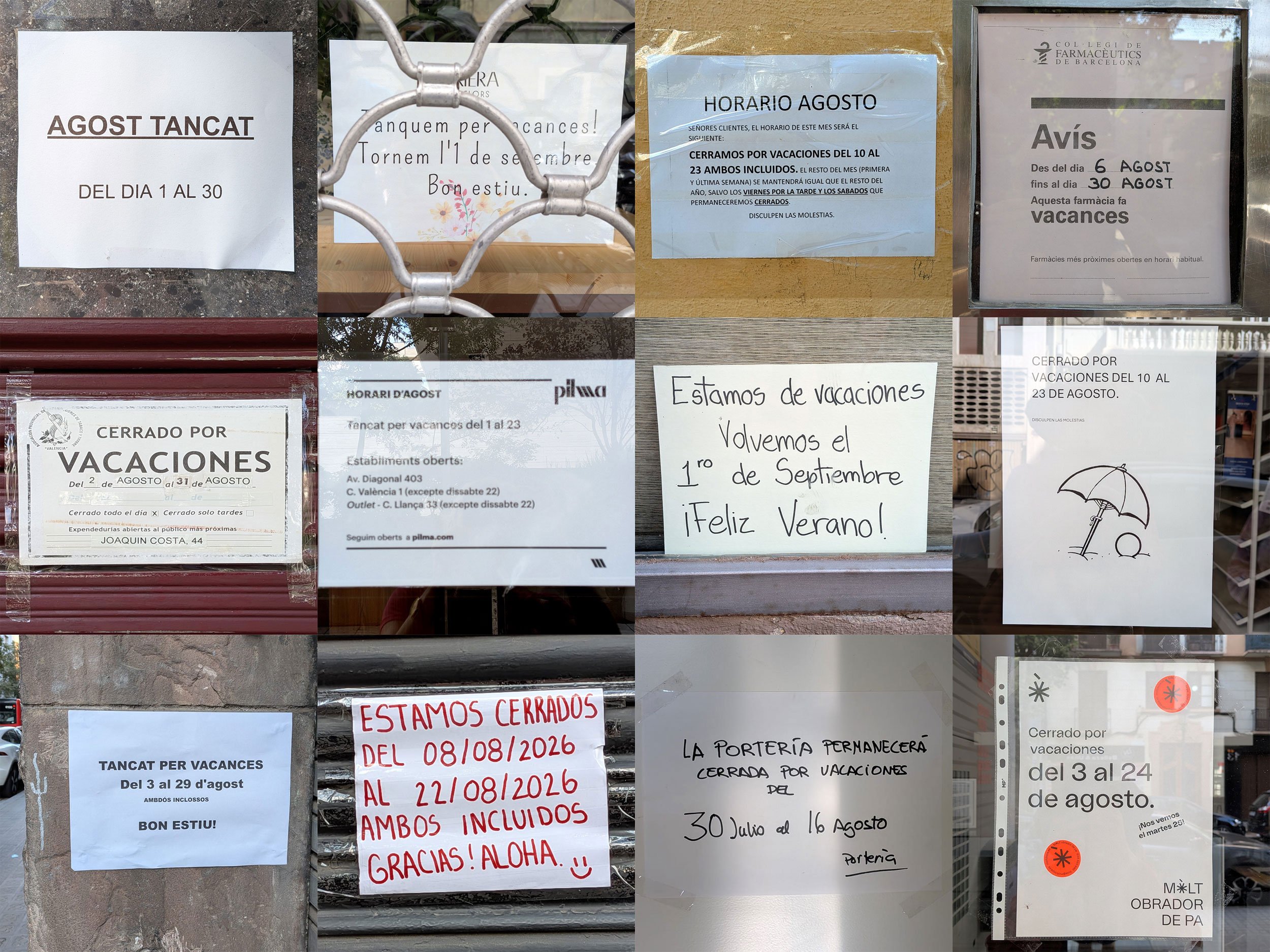
It can be frustrating to show up at a favorite coffee shop only to be met by one of the ubiquitous “Tancat per Vacances” signs taped to the door (closed for vacation, in Catalan). And I admit that my first couple of summers here I bemoaned the ability to get anything done during August – new office chair? Jewelry repair? Pilates classes? It all has to wait until September.
But I have come to appreciate the built-in slowing down of the pace of life and to recognize it for the gift that it is. This is especially true amidst the growing chorus glorifying longer hours and greater productivity – the eighty-plus hour work week that is worn like a badge of honor and is the price, tech leaders tell us, of changing the world.
Why should 80 be the new 40?
The relentless “work harder, faster, better” messages from CEOs and AI evangelists are packaged as ambition, as commitment, and as the price of admission for anyone who wants to be among the people who matter.
It may well be true that growing a multi-billion dollar company requires a near total work focus. And I can understand why these people would want everyone who works for them to work equally hard in service of the company’s bottom line. To agree to CEO Scott Wu’s ask for a 6-day 80-hour work week. To acquiesce to Elon Musk’s demand, when he took over Twitter, for “extremely hardcore” long-hour high-intensity work.
But is working yourself into the ground – literally, falling asleep on the office floor amidst the debris of take-out pizza boxes after a ketamine-fueled work frenzy – really the gold standard to which we all should aspire?
The answer from Spain is a resounding, “No.”
How Spain makes things easier
Spaniards don’t just embrace the idea that there is more to life than work, they have built an environment that supports work-life balance.
Labor laws mandate reasonable vacation time –a minimum of twenty-two days, not including sick leave, plus roughly fourteen public holidays.
Corporate norms mean that people are not expected to be reachable outside of work hours. And cultural norms make it easy to prioritize spending time with friends, developing non-work pursuits, and showing up for family.
The ubiquitous and reasonably-priced menus-del-dia in restaurants all over town encourage people to take a real lunch break rather than gobbling down a sandwich while sitting alone in front of a computer.
And, of course, there is the built-in down time of August.
It’s not that Spaniards don’t like work – from what I see, the desire for work-related purpose, competence, and contribution is just as strong here as anywhere else. It’s just that on the whole they have not bought into the relentless call for more — more hours, more output, more hustle. They are aware not only of what might get built at that pace, but of what might get broken.
Does this mean that Spaniards don’t get as much done? In August, probably. But during the rest of the year, fewer hours do not necessarily mean lower productivity.
Productivity math
It turns out that the relationship between productivity and hours worked is not linear. Way back in 1913, the British Health of Munition Workers Committee looked at productivity among factory workers and – contrary to what factory owners had hoped – found that output tended to rise steadily with hours worked up until about 50 hours and then it plummeted. And even when the work hours overall were the same, the employees who worked without a day of rest were about ten percent less productive overall than workers who had Sunday off.
Research done since then tends to show a similar pattern. So, although some among us may embrace an 80-hour work week, for most of us the sweet spot of productivity is closer to what in Europe is a standard 35-to-40-hour work week.
For highly creative work, that number is even lower. Elite musicians tend to max out after four hours of focused practice per day. Same for mathematicians. It’s a limit I’ve learned the hard way in my own studio work – plugging away longer than four or five hours usually results in me undoing progress rather than adding to it.
And yet hope springs eternal and companies and managers continue to set unrealistic deadlines, pile on excessive work, and demand constant availability – somehow expecting employees even of established companies to work as if they were at a start-up. These managers may get more work out of people in the short term. But they are also likely to get more of what they didn’t bargain for – more employee burnout, more strokes and heart disease, more dissatisfaction, and ultimately more attrition with the most capable employees – those with other options – often the first ones to leave.
What are we building?
It can be hard to slow down when everything about the environment you are in is telling you to speed up. A friend of mine worked at a company that had to hold a special all-hands meeting to remind employees that they were, in fact, entitled to take their vacation days. And yet the day-to-day messaging – the relentless pace, the expectations from management, the fear of falling hopelessly behind if you did take time off – gave the opposite message.
That's part of why I like living in Europe — the culture itself gives you permission to strike a sustainable work-life balance. If you don't live somewhere that supports this, more of the work of building that permission unfortunately falls to you.
It starts by refusing to let tech leaders and social media tell us what kind of humans we are supposed to be. By considering all the things that are important to us that work would happily sweep aside. By making our own choices, to the ability that we can, and finding ways to use our environments – our structures, our routines, and the tweakable parts of our work and broader cultures – to help support those choices.
And you never know when these small changes will add up to something more.
In 1986, a McDonald’s opening in Rome was met with protestors handing out bowls of pasta and yelling, “We don’t want fast food. We want slow food!” And the slow food movement was born.
When Daguerre unveiled the first photograph in 1839, the painter Paul Delaroche lamented, “From today, painting is dead!” But instead, painters began capturing and expressing things that a photograph at the time could not – the fleeting quality of light, the feeling of movement, subjective experience rather than a realistic image. That was the start of the Impressionism movement.
We have yet to see what kinds of enduring movements will be born from reactions to the AI revolution – but I don’t doubt there will be some. As art historian Ella Nixon predicts, “Artists will revolt and assert their creativity as an inherent human capacity. In this regard, I think the physical art world is about to become a lot more interesting.”
No one said it would be easy
As I sit here finishing this post, I am not exactly tancat per vacances but I am definitely slowed down. My writing output has ebbed as visits from family and friends have flowed. The time I spend in my art studio has dwindled because the hot and humid Barcelona summer – along with the lack of air conditioning – has discouraged lingering. I have taken a break from errands because everything is closed anyway.
I realize that not everyone gets the kind of support that comes from having a whole city slow down around them.
Many people live and work in environments where there seem to be no alternatives to long hours and high stress levels. While at the same time being aware that this hardcore work mindset is not a path to a sustainable life – or even to sustainable productivity.
For managers and others who are in a position to make changes to work environments, my question is this: What are you doing to protect and support your people? Because AI or no, your human resources are still your most valuable.
For individuals, it can be harder to see a way forward. It’s easy to give quick advice – embrace one of the increasingly popular slow “granny arts” like knitting, make morning walks a protected part of your day, spend evenings with friends rather than with work. But even these small acts can seem simultaneously impossible and not enough.
Part of the problem is that when we are overtaxed we often simply don’t have the mental bandwidth to think our way out of an unsupportive environment – let alone implement any changes. This is when we could use a little help from our friends. Have someone else read this post and help you think through some small changes you could make. Or grab a drink with friends in a similar situation and share advice – it’s often easier to see ways out of other people’s problems.
But even before that, think of one thing you could do to restore some of your mental bandwidth.
Maybe – like it did for the friend I mentioned earlier – it starts with finally taking that vacation.
Related Posts



In a world designed to capture our attention through ever more sophisticated means, perhaps the most revolutionary thing we can do is to decide for ourselves, with intention and care, what to pay attention to and what to ignore. A rational inattention approach can help us do just that.