Putting The Hands Back In Hands-On
Several weeks ago, I participated in a “hands-on” laptop-powered discussion with a room full of smart people sharing how they use AI.
It was definitely interesting, but was it really hands-on?
In the weeks since that gathering and after my own recent explorations with AI, I’ve taken a step back to think about not only what we are gaining in our rush to stay current and boost our productivity but also what we are potentially leaving behind.
One of the things that I find I’ve been moving away from as I lean more on AI powered thinking partners is my own original OI (organic intelligence) thinking partners – the ones that put the hands in “hands-on.”
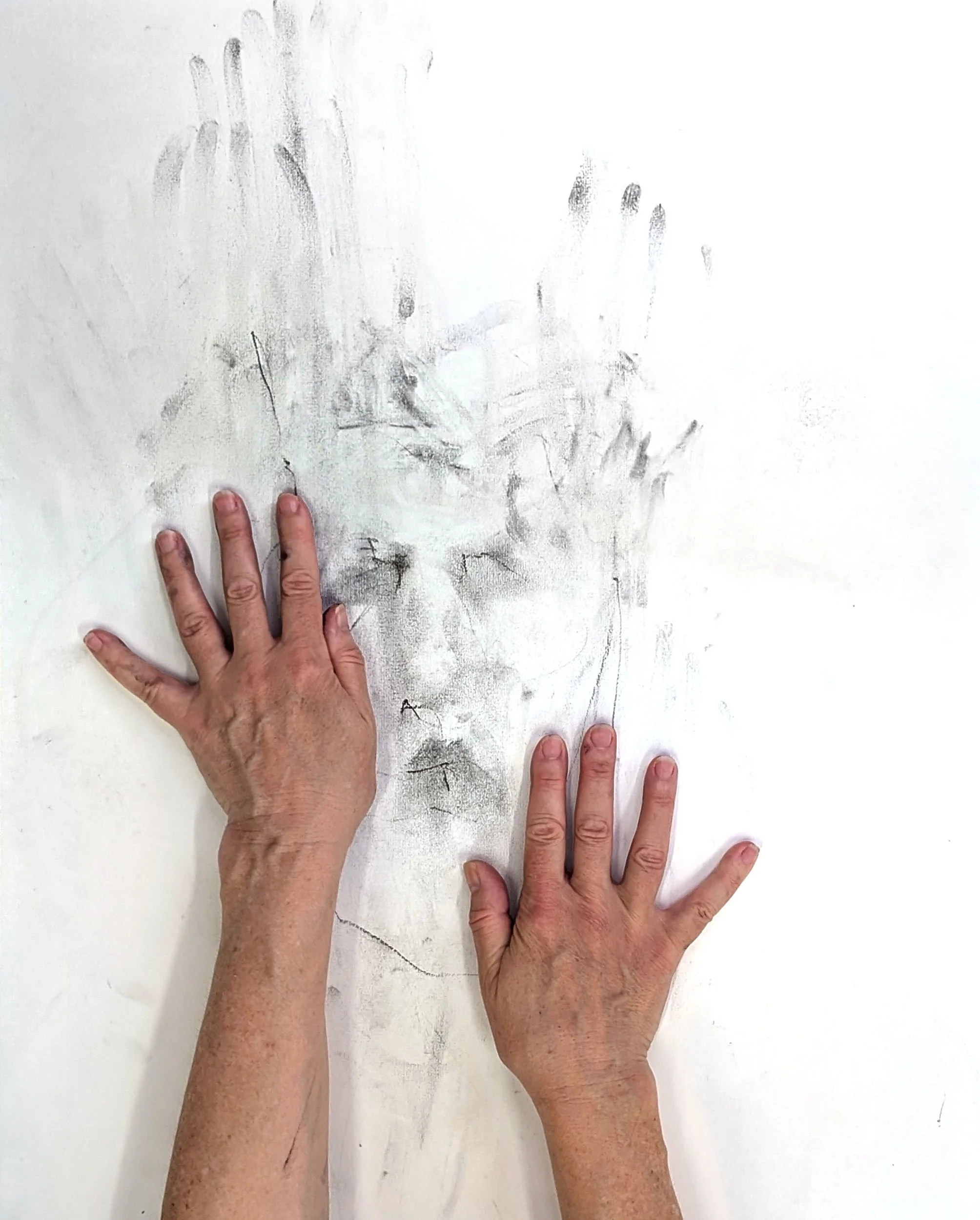
Your embodied thinking partners
It’s easy to think of the brain as the seat of all thought – the big boss that thinks things through, solves problems internally, and sends instructions out to the body to take action.
But that is not actually how things work.
Thinking doesn't run in one direction, from a decision in the head down to an action in the body. It's more of a cognitive loop in which the body is an integral part. In fact, movement and the exploration and sensations it supports is the very foundation of thought. The cognitive structures that we use to map, categorize, and eventually reason abstractly about the world are built largely through bodily exploration. We orient our bodies to take in information. We move through our environments to understand the world. We manipulate objects to figure out how they work.
And even once cognitive structures are created and can run independently in our heads, our bodies and brains continue to co-create thought in a collaborative dance that is usually performed subconsciously. Our bodies test predictions and let us explore things and ideas in an intuitive way. And the feedback this gives our brains ends up changing our cognitive structure, which in turn sparks new predictions and ideas.
Thinking doesn’t just happen inside the head.
And nowhere is thinking more embodied more than in our hands, which are connected to more than 70% of the real-estate in the brain’s motor and sensory cortex.
I know how important hands are to thinking from my own experiences creating art. It was only when I started life drawing that I realized how poor my mental models of the human form were. The bulk and complexity of the shoulders, the relative size of hands to head, the rotation and movement of the thumb – these were some of the things my brain got frustratingly wrong in my early attempts at drawing. Only by involving my hands in the thinking process was I able to make progress – my eyes observed, my hand sketched a rough and easily correctable hypothesis, my brain evaluated, my eyes and hand tried again, and so on. Sketch by sketch, my mental models were updated and my drawing improved.
It’s what Stanford professor emerita Barbara Tversky – who has spent decades studying how spatial actions, sketches, and gestures actively shape human thought – calls a bidirectional feedback loop.
This feedback loop not only helped me improve my drawing – it is also essential for the more conceptual work in my studio. As I have written about before, I have learned that it is only through making my work – from the hands-on process itself – that I figure out how to translate my conceptual ideas into a physical reality even when I can’t fully capture it in words.
That’s part of the power of embodied thinking – it bypasses the limitations of language-based thinking, allowing you to activate, feed, and play with fledgling ideas that you don’t yet have the words for.
Playing with ideas outside of your head also sidesteps another limitation – the brain's famously narrow working memory, which can hold only a handful of things at once. When we offload concepts and ideas from brain to paper we can work with more things at once. And this means that we are more likely to see connections, discover different ways to structure or frame an issue, and find creative problem solutions.
An advantage of ideas that emerge this way is that they don’t come fully fledged. Instead, they start out rough and this leaves room for development, refinement, or redirection.
This is certainly true of the way most artists draw. The hand doesn’t give them something polished in one fell swoop. Instead, the sketchy marks that they audition on the way to a finished drawing demand engagement – reaction, decisions, new marks – as brain and hand work together to find their way.
We talk about AI as generative, but its polish often shuts down the brain’s own generative thought because it assumes there is nothing left to do with a finished image or paragraph. A rough sketch does the opposite. Its mistakes, its ambiguity, the dissonance it creates, the questions it unearths — these things almost demand engagement. They are an invitation to the brain, or brains if working in a group, to push back, get involved, and generate new ideas and insights.
Despite all the contributions our hands and body make to thinking, we as a culture seem to be accelerating away from real hands-on work.
How can we help ourselves put the hands back in hands-on?
Setting yourself up for hands-on thinking
The way we set up our environments and structure our lives can encourage certain behaviors and ways of thinking and discourage others. A blank AI prompt window invites one kind of interaction. Charcoal and paper invite something different.
If we want to keep the invitation for embodied thinking open – not just in the art studio but in our work and daily lives – it might help to give ourselves some structure and guidelines.
Here are three ideas:
Make analog an intentional part of your process. Reach for pencils, paper, and your own embodied OI before you reach for AI. Map out a problem or topic you want to explore using simple shapes and words. Sketch out possibilities for your slides before you turn to standard templates. See what you generate through sketching, diagramming, modeling – or an interpretive dance for that matter – before you turn to generative prompts.
Write it out, old-school. Brain imaging done by neuropsychologist Audrey van der Meer at the Norwegian University of Science and Technology shows that both drawing and handwriting activate vast interconnected areas across the brain while the repetitive act of typing activates a flatter, more localized activity. I’ve had younger people tell me that handwriting is for the older set. But apparently there really is something about the movement of the hand over a surface that encourages a more expansive kind of thinking.
Favor sketchy over polished. The looser and rougher you keep things in early ideation phases, the more participation you will encourage – from yourself and others. Quick hand-made diagrams, sketches, and models invite a kind of participation that polished slides, pristine models, and sleek AI output do not. Brainstorming and ideation processes that use non-precious materials – whiteboard, paper, markers, sticky notes, simple building materials – invite whole-body collaborative thinking. Not only is this kind of effort more fun, it often leads to more and better ideas, creation of a shared vocabulary and understanding, and greater buy-in.
Playing the hand you’re dealt
My kids constantly make fun of me for talking with my hands— I use them to emphasize and illustrate, to describe food, and to share the shape of my ideas.
I used to think that my lively hands were just my Italian half asserting itself over my Irish half. But now I realize that it’s something more than that.
I don't just express with my hands. I think with them — in my studio, in my doodling during Zoom meetings, in my long-hand free-writing around problems and blog post ideas. And this embodied thinking adds a richness that I don’t want to lose – a bidirectional feedback loop that I would like to keep in motion.
So yes, like most everyone else, I will keep exploring new apps and AI assistance but I will also make intentional choices to keep my hands in the game.
How about you?
Related Posts



There is a lot of talk about using AI as a “thought partner,” but how much do you really know about who you are collaborating with? Is your partner going to help build your understanding and bring out your best work? Or are they more like that annoying school project partner who just ends up dragging you down?