The Blindfolded Visitor – A Different Kind of Museum Guide
A couple of years ago I was chatting online with a group of about thirty artists and the talk turned to how we visit museums and exhibitions. The story that made the biggest impact on me was from someone who had gone to see a highly anticipated painting and wanted his experience to be as pure as possible. To avoid being influenced by anything else in the exhibit, he blindfolded himself and had a friend guide him to the painting for the big reveal.
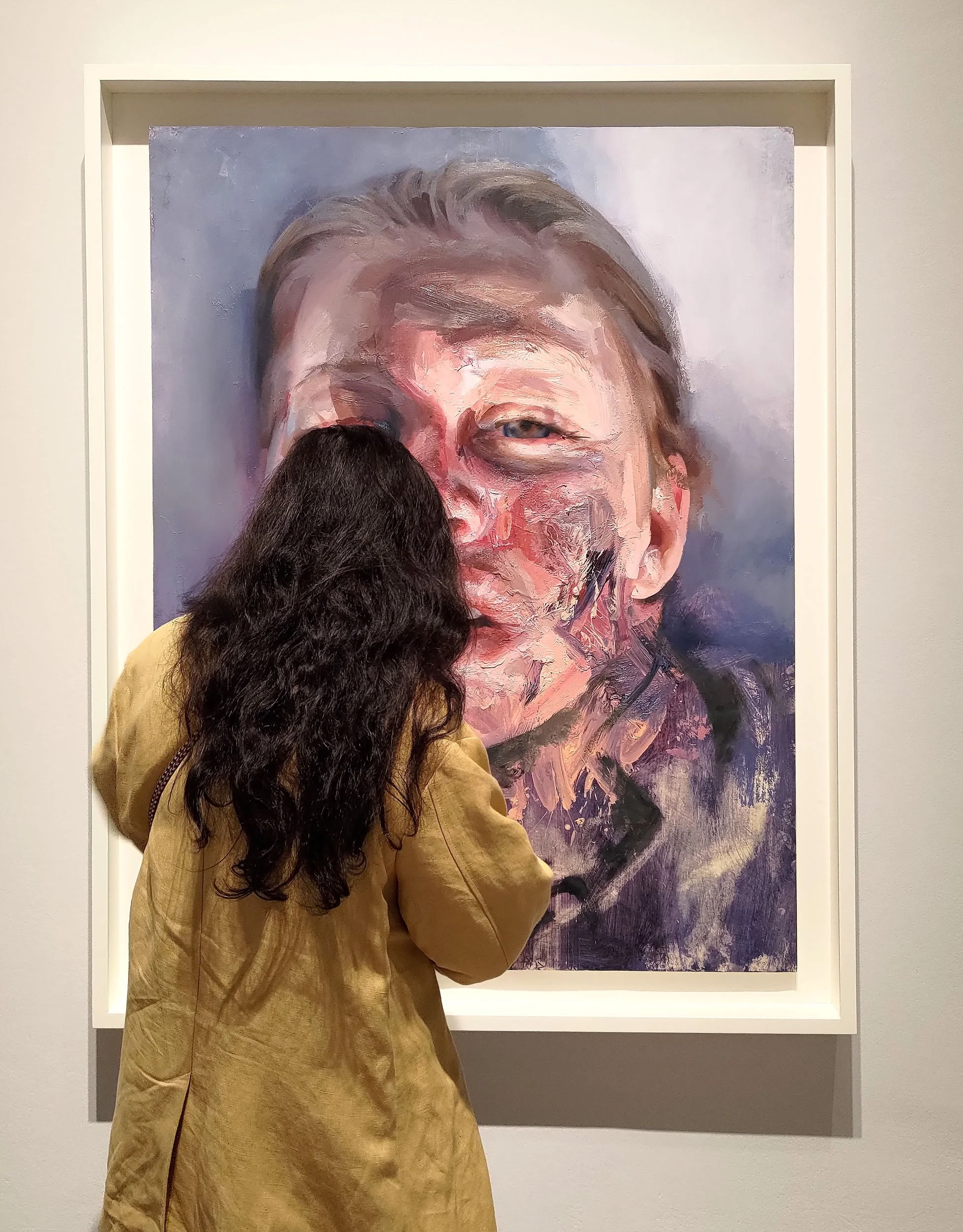
Interacting with Jenny Saville’s emotive portraits, London 2025. Photo: Anne Kearney
This was a pretty extreme tactic. But it does highlight the fact that how we approach a work of art has an enormous effect on how we experience it.
In my last blog post, I wrote about the difference between looking and seeing. This post is a practical follow-up – a guide to visiting museums in a way that encourages genuine engagement. You won’t find the standard advice here – I’m assuming that you already know to get tickets in advance and go when it’s least crowded. Instead, it includes a different set of ideas drawn from cognitive science, artists, and a grandfather named Henry.
What is your brain doing in a museum?
The brain's default is usually to take the path of least cognitive resistance. It tends to like what psychologist Daniel Kahnamen called cognitive ease — the warm, frictionless feeling we get when things are familiar and legible. This helps explain why the famous paintings draw crowds while the unfamiliar ones might barely get a glance.
But a museum visit running fully on cognitive ease is a missed opportunity. Because art is at its best when it does the opposite of easy – when it disrupts, surprises, and opens up new ways of seeing and understanding.
The idea that art provides sustenance for our brains is the premise of a book I’m currently reading called Mona's Eyes by Thomas Schlesser. In the book, a young girl named Mona is at risk of losing her sight within the year. Her grandfather, Henry, determined that she should carry beauty with her into the darkness, takes her to the Louvre once a week when he is supposed to be taking her to a therapist. Instead of wandering through the collection, they spend their time each week in front of a different single painting. Henry knew intuitively what the science supports – that art can leave a lasting impression but that truly seeing requires slowing down and expending some effort.
How can we slow ourselves down and what kind of effort is worth expending? What follows are some of the things I’ve been thinking about.
Navigating context and experience
When Mona first stands in front of a painting, Henry instructs her to simply look — in silence, without commentary or explanation.
Henry understands what the blindfolded artist understood – that our encounter with a work of art is shaped by everything we bring to it. Your own prior knowledge, a work’s reputation, a guide’s narration – all of this primes the brain to see in a particular way and can anchor and limit what we take away.
Some artists in my online discussion valued this “pure” experience of art so much that they even considered reading the painting labels a moral failing. And we all admittedly poked fun at the many museum-goers who spend more time reading than looking – as though the artwork is only legible through someone else’s lens.
But I am not fully in the pure experience camp. There is certainly value in approaching a work cold, but less context does not always equate to a richer experience. On the contrary, context can deepen the experience by giving the brain more threads to work with — things to notice, ways of thinking about a work, connections to make.
My own approach is to experience the artwork first and then dig into the context. I want to give my own impressions time to bloom but I also want to know the title because a thoughtful one can illuminate what the work meant to the artist. And I appreciate a bit of context – not to replace my own observations, but to expand them by opening up new ways of interpreting what I see. The same logic applies to pre-visit research. Reading about an exhibition beforehand can prime your attention in useful ways — but it also colors your experience before you've had one.
There is no right way to approach a museum visit. But it might be worth being intentional about how much you want to know before you walk through the door.
When less is more
Many museum visitors feel a low-grade obligation to see everything. The tickets weren't cheap, this may be your only chance, and there is a vague anxiety of missing something important. The result, as anyone who has staggered bleary-eyed out of a major collection will recognize, is a kind of visual and cognitive overload in which almost nothing sticks.
The brain has limits when it comes to paying attention and absorbing new experiences, and a museum can push past them faster than you might expect. For me, the saturation point arrives somewhere around the two-hour mark. Past that, I'm not really experiencing anything, I am just moving through space.
Respecting your brain’s limit isn’t laziness, it’s good cognitive sense. This means that you are not obligated to see everything. That you do not have to follow the prescribed viewing order. That it’s okay to leave when you feel your attention waning.
Henry's method — one visit, one hour, one artwork — takes this principle to an extreme that won’t suit many of us. But the underlying instinct is sound – it’s almost always more valuable to see fewer works deeply than many works with a cursory glance.
When more is more
While less is usually more in the context of an exhibition as a whole, more is often more in the context of a single artwork.
Henry instructs Mona not to attack a painting with her eyes but to let her vision soften and wait for the painting to come to her. He asks her to notice not just what is depicted but how — the quality of the light, the pressure behind a brushstroke, the decision to leave something in shadow.
Research on how the brain responds to art suggests that this kind of deep visual engagement does something different from ordinary looking. When we observe a bold brushstroke, a reaching hand, or a blissful expression, our motor and sensory neurons fire in ways that mirror the painted action – as though we are briefly inhabiting that artist’s mark-making, or reaching out our own hand, or feeling that bliss. This kind of neural mimicry – even if you are not aware of it – can transform viewing art from a passive experience into a visceral event that begins to blur the line between canvas and self.
Contemplating art can also activate the brain's default mode network – the system associated with memory retrieval, self-reflection, and personal identity. This activation can spark a dialog – conscious or subconscious – among the artwork and your inner self. This is why viewing a centuries-old portrait can feel like a private conversation and why some works can unexpectedly unearth emotions or spark ideas.
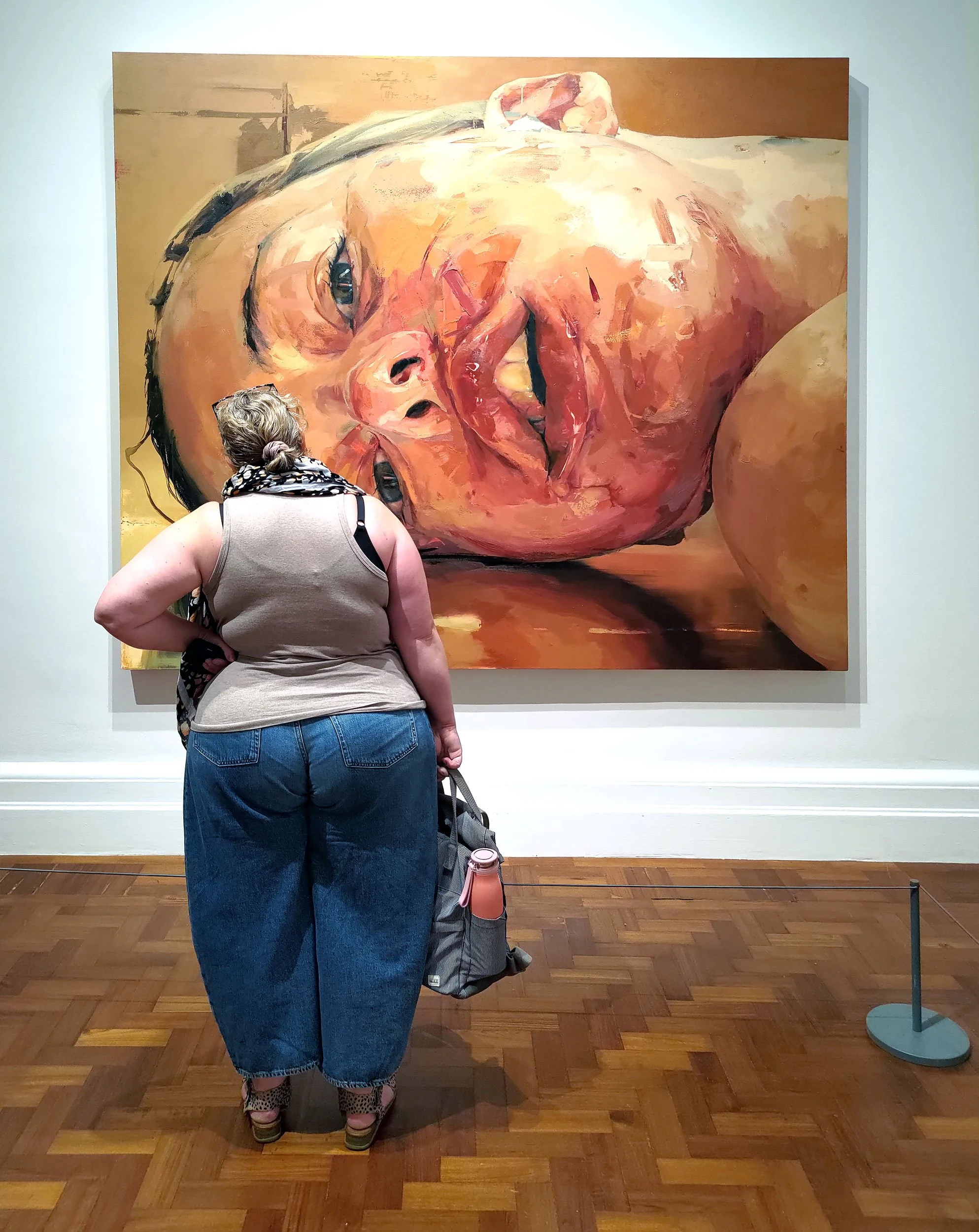
At the Jenny Saville exhibition, London 2025. Photo: Anne Kearney
Discomfort is a signal, not a verdict
Long ago an artist advised me to spend time with the works I didn’t like because they probably had something to teach me.
The brain's preference for cognitive ease — the familiar, the beautiful, the immediately legible — over cognitive discomfort is a bias meant to keep us safe in possibly hostile territory. It is not a way to navigate a museum. Discomfort in a museum – when you glance at something and don’t understand it or feel vaguely put off – can be a signal that there is something worth learning if you only give it time.
The last look
Before I leave an exhibition, I tend to go back to the one to three works that most affected me. This gives me more time with those works and also helps distill what could be an overwhelming experience into something my brain can hold onto.
We tend not to remember experiences as continuous records but as peaks, dips, and endings. This last look is my way of holding onto those peaks rather than leaving with just a vague impression of having enjoyed myself. Henry understood this too — his weekly visits with Mona were never about passive enjoyment or about seeing it all, but about making what Mona saw count.
I haven’t finished Mona’s Eyes and so I don’t yet know whether she ends up losing her sight. But just that possibility is a reminder that having the opportunity to experience artwork in real life – whether the work is beautiful, strange, baffling, or boring – is a gift.
It is a gift that should not be squandered. Because when we take the time and effort to genuinely see, the brain we carry out is not quite the same as the one we brought in. And there is no telling what doors that might open.
Related Posts


A visit to the Uffizi left me less interested in the paintings than in the people looking at them. What I noticed got me thinking about how the brain actually sees, what happens when we stop observing, and why it matters beyond the walls of a museum.