A Predictably Great Weekend in Copenhagen
I recently spent my birthday weekend in Copenhagen – a city full of charming architecture, friendly tall people, deliciously soft cardamon buns, and an astonishing number of unlocked bicycles. I had heard about the people and the food, but the bicycles took me by surprise.
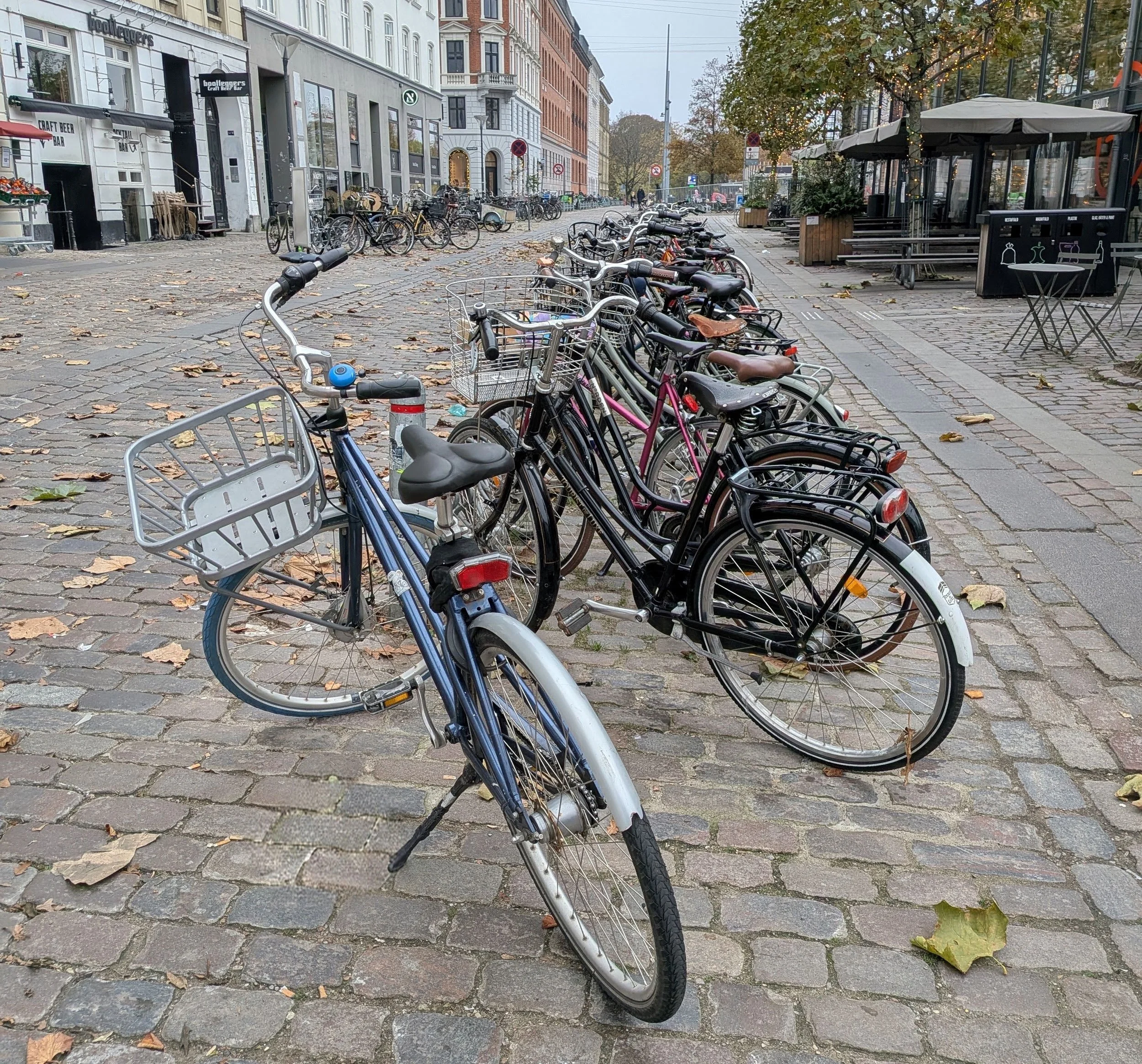
The apparent lack of vigilance among the Danes stressed me out. Weren’t they worried about their bikes getting stolen? Wasn’t the way they casually left their coats on long unmonitored racks in museum basements an open invitation to thieves? Wasn’t the fact that they didn’t have to show or scan tickets on public transit a recipe for escalating rule breaking?
It took me a couple days to relax into the reality that the Danes don’t worry about these things because they so rarely happen.
When you live in a culture that ranks among the highest in the world on measures of rule-following and generalized trust in both people and systems, you are afforded the luxury of relaxing and letting your guard down. It is no coincidence that Denmark ranks among the lowest of countries for level of everyday worry and stress.
The price of uncertainty
Spending time in a city where I could let my guard down made me aware of just how much mental energy it takes to keep my guard up.
Feeling threatened or even just uncertain revs up your brain. Where are my belongings? Is someone out to get my phone? What is that stranger going to do? Even if you are not actively thinking these things, your brain is staying vigilant by running different scenarios in the background and making a series of corresponding micro-decisions. It is your brain’s way of trying to keep you safe in the face of uncertainty.
But these background calculations come at a cost. In the short term, these “what ifs” are taking up some of the brain’s limited working memory, leaving less room for other things like planning your weekend, solving a problem, making creative connections, or being fully engaged in a conversation. In the longer term, background vigilance and decisions siphon off some of your limited mental bandwidth leaving you with less capacity to deal with whatever else the day throws at you.
Hygge predictability
As Denmark has consistently topped the UN World Happiness rankings, the world has latched on to the Danish concept of hygge – widely interpreted as consisting of wool socks, flickering candles, hot cocoa, and unhurried evenings with close friends. I certainly felt a warm glow when we walked out of the cold and into a candlelight cafe complete with a basket of blankets in case we felt a chill.
But there is much more to the Dane’s happiness and low stress levels than twinkling lights.
In Denmark, the concept of hygge goes well beyond a cozy feeling. It is more about the relaxed state of mind that happens when you are in an environment that is not only physically comfortable but also comfortably predictable. One where threats, social friction, and uncertainty have been left at the door and where the brain can dial its background vigilance way down and focus on more nourishing things.
In that sense, Denmark as a whole seems like a pretty hygge place.
When rule-following is a cultural norm, you don’t have to spend background mental energy wondering if your bike is safe. When a safety net of social services exists, your brain doesn’t have to continually run and worry about untold “what if” scenarios. When everyone else is paying their taxes, it makes you happier about paying yours. When you know that the rule-of-law is being applied fairly, it removes the nagging feeling of being an honest sucker.
Predictability gives the gift of mental freedom from a background workload we didn’t even realize we were carrying.
Bringing home a bit of Copenhagen
Back in Barcelona – where people are not as apt to follow rules and where the system sometimes seems to support rather than thwart petty theft – things are less predictable and I am very aware that my vigilance dial is turned back up.
There’s not too much I can do to change the culture or the systems that support it – it’s too big a job for one person. But there are ways to increase predictability on a more micro-scale.
On a personal level, this could be everything from a feng shui furniture arrangement that gives you a view of the room’s entrance, to cultivating habits like automatically moving your backpack to the front when you enter a metro station, to establishing routines that relieve the uncertainty and decision-making burden around, for example, whether and when to exercise.
Extending the idea of designing for predictability to work and other social settings can magnify its benefits.
A hygge-inspired redesign of these environments has less to do with the physical space – although who wouldn’t love a hot chocolate machine and some Danish mid-century furniture in their workplace – and more to do with replacing ambiguity with predictability. Because just like with countries and their citizens, studies show that organizations that have clear and predictable expectations tend to have more satisfied and less stressed employees.
Spelling out roles and responsibilities is a good start. But it’s also important to infuse routine actions with predictability. What’s the meeting agenda, goal, and expected duration? Are schedules and deadlines well thought out or are they simply based on a manager’s pie-in-the-sky dream? Are steps being taken along the way of a project to reduce uncertainty? Are employee evaluation metrics clear and fairly applied?
Seemingly small things can also have a big impact. During my years in a shared art studio, for example, the lack of clarity and predictability around shared resources was a small but constant source of stress. Whose responsibility is it to clean the large sink? What travesty awaits me in the shared kitchen? Can I trust that people are locking up correctly?
Making room for what matters
Of course, if everything was predictable, things would get pretty boring. Surprise and even a little friction is part of what makes life – and cities – worth exploring. Creating a supportive environment isn’t about eliminating uncertainty, it’s about reducing the kind of uncertainty that distracts us by putting a portion of our brain on patrol.
Because if you’re not burning mental energy staying vigilant, second-guessing people, reading between the lines, or just trying to figure out what the heck is going on, you have more energy for the important things. Things like doing good work, creating, learning something new – and of course, cozying up with gingerbread biscuits and good company, wool socks and all.
P.S. My blog posts are a product of my decades of work in environmental psychology and my lifelong commitment to creative practice. Would you like to learn more about how our environments affect our thoughts, emotions, and behavior and how we can leverage our environments to support ourselves in bringing out our best? I suggest you start with the framework – developed by pioneers in the field of environmental psychology – at reDirect.org.
Related Posts


The sudden appearance of a large sinkhole near my Barcelona art studio was a stark reminder that we are all floating on vast interconnected scaffolding that can either hold us up or suck us under. How can widening our awareness help us spot the cracks in our foundation before the ground shifts underfoot?