Under Our Feet – The Hidden Scaffolding of Everyday Life
I don’t generally think about what’s going on underneath me as I walk through Barcelona’s streets. The tendrils of my awareness usually stop at ground level which gives me the comforting illusion that I am walking on a predictably supportive and solid surface.
The fact that the space beneath me is not solid and inert but is instead a complex web of underground metro tunnels, hidden waterways, pipes, electrical cables, small critters, roots, and fungal networks is easy to ignore because I seldom have reason to consider how these things affect me.
These things are easy to ignore, that is, until the ground shifts.
That’s literally what happened this past July when an eight-meter diameter sinkhole opened up in the bathroom of the pizza place a mere block away from my art studio. For everyone who lives or works in the vicinity – and particularly for those residents who had to evacuate – it was a powerful reminder that we are all floating on vast, largely unseen, shared scaffolding.
I mean that literally but also metaphorically in terms of the people, processes, culture, and other things that affect our lives whether we are aware of them or not.
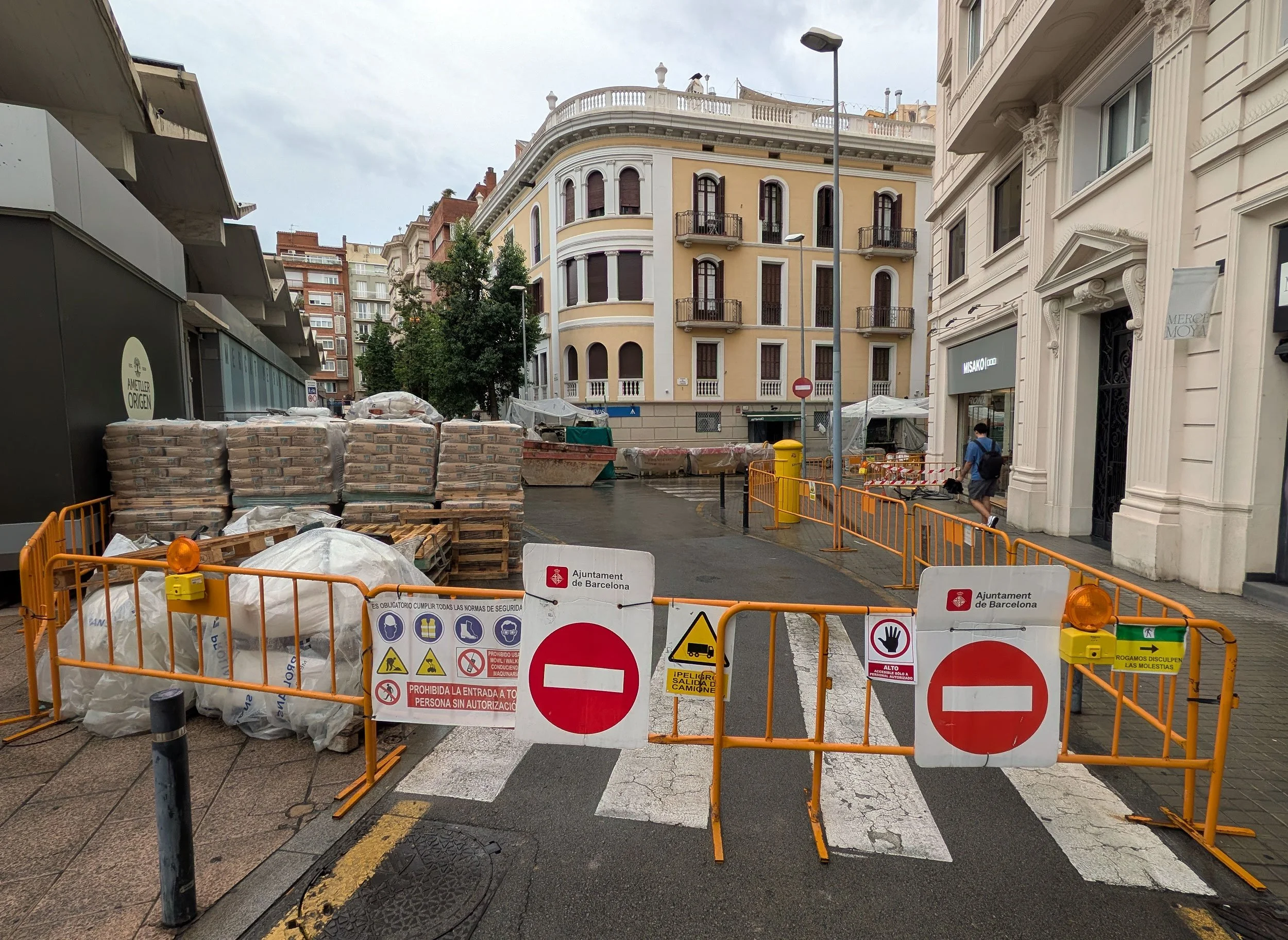
The sinkhole in Barcelona’s Sant Gervasi neighborhood is hidden from view, but the work site reminds us of how much we don’t consider until it breaks.
Everything, everywhere, but not all at once
It can be alarming when we unexpectedly get a glimpse at what is really going on behind the scenes of our own one-person play. When we realize how little we actually control. When we see that we are not self-contained individuals but rather small parts of a complex interconnected system of people, places, and things.
No wonder we default to ignoring most of it as we walk through our day.
Selective ignorance is neither accident nor laziness. Our brains and sensory organs have evolved to ignore far more than they perceive. Our eyes only react to a tiny part of the light spectrum. Our ears only respond to a limited register. Our brains are only able to process a small amount of information at a time.
Only by filtering out so much are we able to keep from getting overwhelmed. Our limited awareness is what allows us to create a coherent sense of reality. It keeps us from getting mired in helplessness by creating the illusion that we are the main drivers of our own destiny.
And yet when we keep the tendrils of awareness too close, we miss opportunities. We also risk stepping on the toes of those around us.
I have climbed many metro stairs, church towers, and mountain view points since living in Europe and there is always that one person who is so focused on their own journey that when they finally reach the top they simply stop – right in the middle of the path! – for a rest. “Keep moving!” I want to scream. Or if you absolutely cannot, at the very least broaden your awareness just a little and realize that you are part of a flowing pipeline of people that you have brought to an uncomfortable standstill.
Fortunately, most people aren’t quite so myopic. But I think it is fair to say that many of us could benefit from extending the tendrils of our awareness a little bit further.
Tweak your mindset to get out of your head
Extending your awareness is not about trying to notice every pipe, process, and person in the complex web of our surroundings. That way lies information overload and can be a quick path to paralysis.
It is more about shifting your mindset and giving your brain some support in seeing what often goes unnoticed. It is about being aware of the fact that you are not just an individual agent but also a member in a vast interconnected system. And then putting structures or reminders in place to help you pay more attention to what’s going on around you.
Becoming more situationally aware makes us both more resilient and more empathetic. We can’t anticipate every ground shift. But with a little more awareness we might be able to see cracks that could be filled or feel the early vibrations that portend problems. And that foresight can give us opportunities to shore up our foundations before a crisis unfolds.
Strengthen your awareness muscle
Simply telling ourselves to be more aware is unlikely to have a lasting effect – we are, after all, creatures of habit. Thankfully, habits can be changed through a combination of creating favorable conditions and practice.
I have created a habit of considering the bigger picture affecting my creative practice by implementing a structure of monthly reflections. I think back on what I did but I also intentionally ask myself what supported my successes and what derailed my good intentions. Being ever more aware of the invisible scaffolding that supports – or thwarts – my creative work reminds me that it’s not all about personal discipline. And this helps me set the stage for good things to happen more often.
Finding ways to flip your perspective from an inward focus on your own needs and goals to an outward focus on other people and their needs is another way to expand your awareness – with the added benefit of helping others.
One team leader who participated in a recent workshop I gave said she has started imagining her team members with big batteries over their heads that show the state of their mental bandwidth. Are they fully charged, running low or completely depleted?
This encourages her to notice things about her team members and switches her mental dialogue from, “What do I need to tell this person or ask of them?” to, “What kind and amount of information is this person capable of receiving at this moment? How can I make our interaction more effective by meeting them where they’re at? How can I support them in protecting or recharging their mental battery and being more effective?”
A return to solid ground – almost
We all need a stable surface on which to walk – and a manageable world view in which to operate. And so, by design, we will continue to be happily oblivious to much of what goes on around us.
Despite the pile of cement and ongoing work near my studio, I have already gone back to the comforting illusion of walking on solid ground.
Yet at the same time, my near-miss sinkhole experience has reminded me that while it may be better to ignore the threat of things we cannot prevent, there is also wisdom in widening our gaze. Because when we see what’s holding us up – or holding us back – we give ourselves the opportunity to reinforce our foundations to better support ourselves and those walking alongside us.
P.S. My blog posts are a product of my decades of work in environmental psychology and my lifelong commitment to creative practice. Would you like to learn more about how our environments affect our thoughts, emotions, and behavior and how we can leverage our environments to support ourselves in bringing out our best? I suggest you start with the framework – developed by pioneers in the field of environmental psychology – at reDirect.org.
Related Posts


People are designed to be curious just like greyhounds are designed to run. Both can probably still survive if those natural tendencies are caged, but they are unlikely to flourish. How does curiosity help us be our best selves? What can we do to free our curiosity if we find it has been caged through neglect, complacency, or an inhospitable environment?