(Micro) Breaking Up With My Art Practice
It is easy to treat time as an unchangeable container in which we live – a fixed environment that exists “out there” and over which we have no control. If this is true, we have only ourselves to work with if we hope to make better use of the ticking moments.
But what if time is not fixed but malleable? What if the textures of rush and stillness, scarcity and abundance, aren't features of time itself but of the architectures we have constructed around it?
Could we reshape time to better serve our needs and intentions?
Philosophers and physicists have long grappled with the nature of time. Is it constant or relative to velocity and gravity? Does it flow in one direction or exist in a 4-dimensional block? Is it infinite or does it repeat?
But despite the lack of a shared understanding on the nature of time, there is one thing on which people do agree. Our experience of time – in other words, what time “is” for us – has as much to do with the quirks of our brains, temporal architectures, and collective agreements as it does with what is happening on a cosmic scale.
Time flies when you are in a flow experience. It crawls painfully along when you are bored. Crises extend time, unfolding in slow motion because there is so much for your brain to pay attention to and encode. Routine experiences compress time because there is not much new for the brain to hold onto. And living in a new culture can throw how you think about and experience time completely out the window.
Looking at time as fluid rather than fixed highlights that we have more power over shaping our temporal environment than we probably realize. And as part of my quest to reshape my environments to better support my 2026 creative intentions, I decided to dig a little deeper into how I might manipulate my own environment of time.
The architecture of time
Most of us live in temporal environments that we inherited or that have been imposed upon us. The temporal architecture of education—50-minute classes, a two-semester academic year —shapes our learning experience. Standard work weeks and hours shape our productivity but also how we socialize and parent. Quarterly business reporting cycles shape corporate decision-making. Policies around the timing of sabbaticals, parental leave, and retirement shape life transitions.
Sometimes we are not even aware that temporal architecture is a choice until we see other patterns. The Spanish siesta may be frustrating to tourists, but a culture that builds in time for a break and long meal is choosing a different temporal reality – one that serves connection over productivity. France’s laws restricting after-hours work emails help reshape the temporal expectations of professional life which in turn gives people more time for other things. The rhythms of feast and fast, work and rest of different religious calendars shape time in order to support reflection and community building.
Taking matters into our own hands (and minds)
We can’t always directly change the big temporal architectures that surround us, but we can often redesign our own personal architectures by making choices about boundaries, rhythms, social contracts, and how we structure our days.
This approach is not about increasing productivity by figuring out how to pack more into the time you have. It is about tweaking the structure of time itself – organizing, expanding, contracting, breaking it up – to help support the experiences you want.
What might this look like in practice?
Reshape your temporal architecture
Making a schedule is a tried-and-true way of supporting intentions by structuring the temporal environment. And it has the added advantage of preserving mental bandwidth by relieving us of the need to continually decide what to do next.
You can take scheduling a step further by thinking about how to take advantage of your own natural rhythms – for example using mornings for focused work when your attention is fresh, afternoons for collaborative or routine tasks, and evenings for socializing and decompression.
You could take it a step further still and build rhythms and gateways into your temporal architecture. These could be bridges between temporal zones in your day like a walk between work and home, making tea before a meeting, or a mini-meditation to reset between different tasks. They could be something you do monthly like reflection or planning. Or they could be seasonal – spring cleaning, a winter self-care retreat, a summer adventure.
Breaking up time through rhythm and gateways not only helps to recenter the mind. It also helps prevent temporal bleeding – where everything is done in one undifferentiated rush so that by the end of the day or year, you can’t really remember what you did.
Reset temporal expectations
Creating norms and expectations around availability can help protect and slow time, which in turn can help support your own needs. What if you let it be known – to yourself and others – that you don’t check messages after 8pm? That you are offline on Saturday morning? That you would prefer a scheduled meeting rather than on-the-fly work interruptions?
By creating new temporal architectures for how and when you are available, you can help support not only your mental bandwidth but also your goals and intentions.
Create routines and rituals
Routines tend to contract time and make it run smoothly, thus requiring less fuss and energy to get things done. I get up and unload the dishwasher without thinking about it because it is part of my morning routine. I stretch before I work out because I have built it into my routine and it has become an effortless habit.
Rituals are in some ways the opposite of routine. They expand time by slowing us down and bringing our awareness to the present. Incorporating small rituals into your day can infuse an otherwise time-starved day with time-rich moments. I have a small ritual of starting my studio day by brewing a cup of tea and enjoying it while wandering around my space. I find that this is a consistent and gentle way to anchor me in the present and help ease me into creative time.
Do something new
Deliberately injecting fresh experiences into your life is another way to expand time so that you can engage with it more fully. The desire to slow and expand time was one reason my family decided to move to Europe (for what was supposed to be two years). Life in Seattle was good, but as one experience bled into the next, I had the sense that I would wake up in twenty years and have no idea where the time had gone.
Build in more breaks
Putting a brake on focused thought by breaking up time helps you out in two ways. First, the brain often does the important work of consolidating and cementing new information when it is not actively engaged in the task. Second, regular short breaks (even as short as fifteen seconds) can help clear mental fatigue and return you to your usual temporal flow with a sharper focus.
During a recent workshop that I led, I used the power of micro-breaks to help people maintain their mental bandwidth. It was effective enough that “15-second microbreaks” was an unintentional workshop take-away for many.
My small experiment with time
It is often easier to see what other people need and to give advice than to turn a critical eye inward. In thinking about time, I realized that this was especially true for me when it comes to breaks. I know about the power of breaks, I harness the power of breaks when working with other people, yet I am forever pushing myself past the point of usefulness.
I am as guilty of doing this in my art studio as I am in my other work.
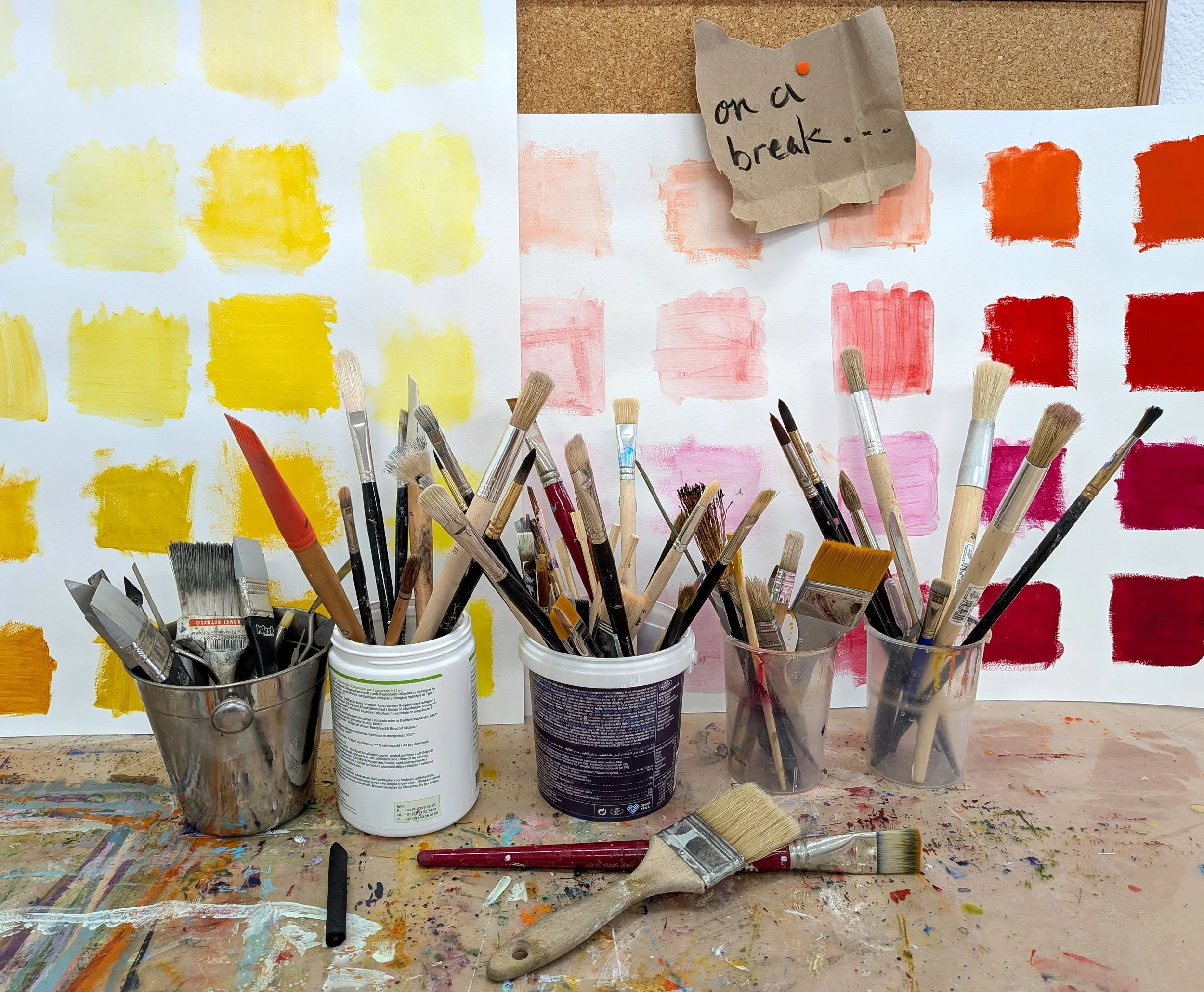
So, as a small experiment in reshaping my temporal environment to support my studio work, I am starting to incorporate more breaks into my work flow. In addition to my usual longer break at lunch, I am taking mini breaks – three to five minutes or so – when I find myself at a loss for what to do next. So far, this has proven much more effective than my usual approach of doggedly sticking with it and trying to think my way forward.
I am also experimenting with taking micro-breaks – even just 15 seconds – when I move between tasks or from one work-in-progress to another. How will this affect my work? Only time will tell.
How about you? What is the temporal architecture of your own life? How could you reshape it to better support your needs or intentions?
Related Posts


Supportive Environments for a New Year, Part 2
As part of my ongoing exploration of how to reshape my environments to support my 2026 resolutions and intentions, I consider the formidable power of the information environment. What does my world of information look like? How might I reshape it to better support my needs and intentions?