Finding Refuge In Making A Mark
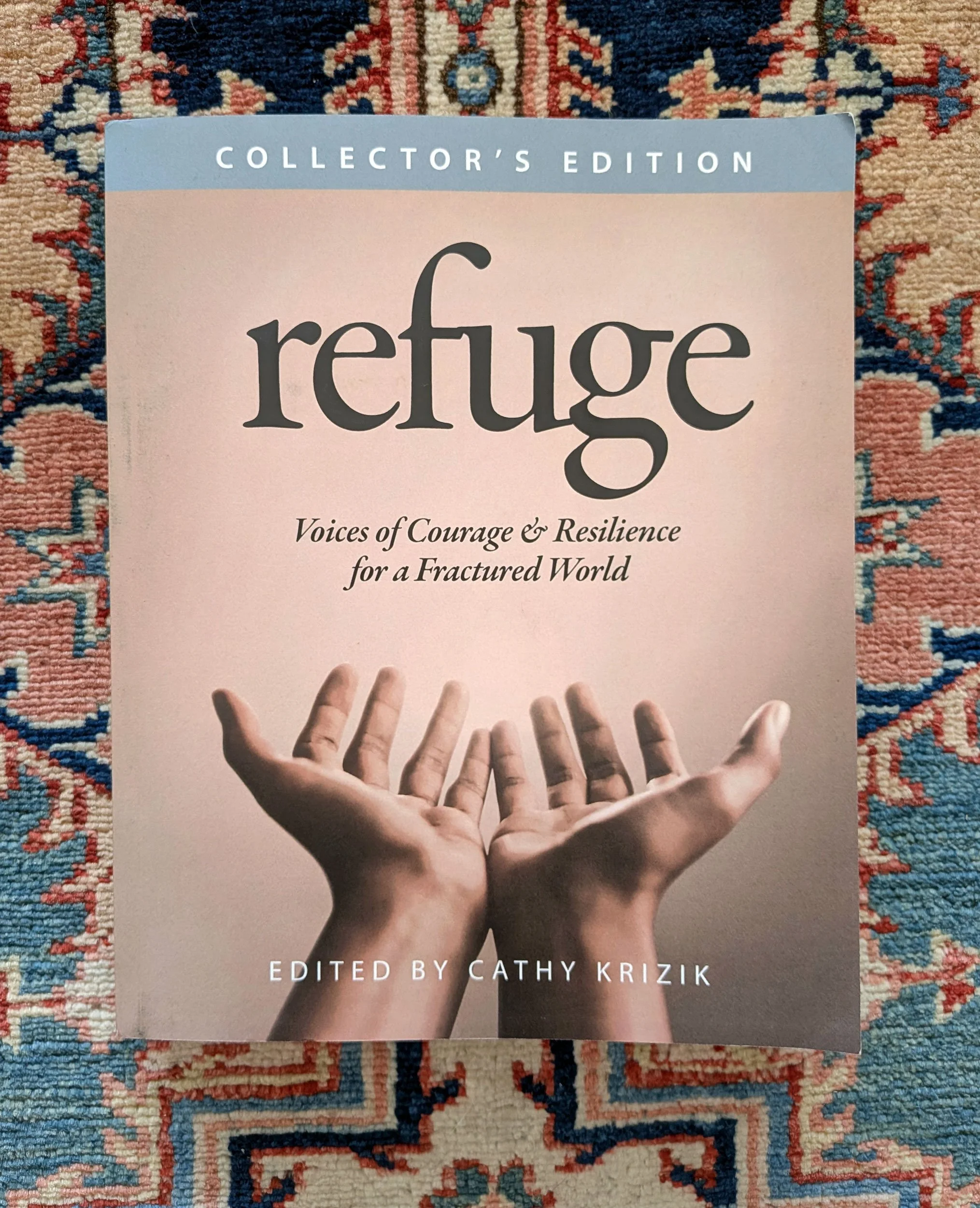
I am very grateful to editor Cathy Krizik for including my essay and artwork in her new book – REFUGE: Voices of Courage & Resilience for a Fractured World.
Books take time to bring to fruition and because I wrote and submitted this essay more than a year ago, I naively worried that maybe it wouldn’t be timely when it was finally published. But now with AI fear and uncertainty added to the mix, many people feel the world is more divided and dangerously off course than ever.
Cathy’s book features more than 100 writers and artists—from emerging voices to established, award-winning contributors—and explores how we endure and remain openhearted during times of division, anxiety, and upheaval. The Collector’s Edition includes full-color artwork (including one of my pieces) and the Reader’s Edition is text only.
I am including my contributions here for you to enjoy – we could all use some refuge.
Finding Refuge In Making A Mark
Over nine thousand years ago, a group of women, children, and men gathered in a cave at the base of a stepped cliff in what is now the Pinturas River Canyon in Patagonia to make their mark. Armed with paint made from ground earth pigments and spraying tubes made from hollow bones, they ventured into the dark, splayed their hands against the rock wall and blew paint to create a collage of stenciled handprints – white from kaolin, yellow from natrojarosite, red and purple from iron oxides, and black from manganese oxide.
No one knows for certain why they did it. Paleontologists think the mark-making might have been part of a hunting ritual, an initiation rite, a form of worship, or a way to claim territory. But as an artist, I cannot look at the abundance and exuberance of these marks without thinking that surely part of the drive behind these paint parties was simply the sense of purpose and even joy in the mark-making itself. A way to lay claim to one’s place in what must have often felt like a harsh, precarious, and uncertain world by affirming: We are here. We matter. We can make a mark on the world.
An expression of agency may have been particularly important for these early humans as they were surely keenly attuned to the delicate balance between self and environment, between intention and circumstance, between predictability and chaos. Reality as they experienced it meant living with uncertainty, knowing that some things can be controlled but many cannot, and that setbacks are inevitable. Within this reality, people did not have the luxury of becoming complacent. The desire to survive gave them no choice but to meet the world head on with a collaborative effort to make sense of things, to create order, to shape their environments – to make their mark.
But the times have changed and many of us now live within fortresses of predictability that we have built through generations of culture, science, and innovation. I grew up in a place and time of relative political, economic, and familial stability. I operated under the illusion that things would continue to make sense and largely go my way. I disregarded how much of my life and successes were due to accidents of circumstance – of my birth, my family and friends, the freedoms supported by my culture, and all the other ineffable confluences of events that translate to luck.
When we are used to thinking of the world as orderly and predictable, it can throw us off balance when something happens that we neither saw coming nor can fully understand – a health crisis, the sudden and unfair loss of a loved one, a rapid destabilization in what we assumed was a robust political or economic system. And when we are out of practice with experiencing and managing the unexpected and unsettling, we may be more likely to respond with withdrawal rather than action, with helpless rather than fortitude.
Covid was the first big disruptive event in my life. The awareness that a destructive and unpredictable force was on the loose upended my neat mental models for how life was supposed to go. The stringent quarantine in Barcelona, where I was living, meant a loss of control over things as basic as my social structure and my own mobility. The news became a constant stressor. I had the sense of being held in stasis, of time and opportunities slipping beyond my grasp, of having lost the ability to affect my own destiny.
My instinct was to seek refuge through retreat and this is exactly what I did. Like the pill bug who meets danger by curling up in an instinctual act of self-preservation, I stayed inside and stopped following the news. At the time, this response made sense – sometimes we do need to retreat and regroup when faced with the incomprehensible or dangerous.
But while withdrawal may be a necessary short-term strategy for survival, as our long-ago ancestors intimately understood, retreat is not a way forward. Life not only requires effort and participation, it thrives on those things and we suffer when we let our need to take refuge from uncertainty and chaos overshadow our needs to be engaged, to feel a sense of purpose, to exercise our own competence.
What ultimately got me through quarantine and the long uncertain months that followed, was finding ways to take action, to exercise my own agency – to make a mark. I cooked more vegetables, I sewed and shared masks, I scheduled time to virtually check in with far-flung family and friends, I began writing my blog. I also took refuge in my small home art studio where I literally began making marks both as a form of meditation and as a strategy for gently finding my way into a new body of work.
Since Covid, I continue to turn to the nourishing power of mark-making as an antidote to powerlessness and uncertainty. When I reach a dead-end in my artwork or become frustrated with my inability to translate my conceptual ideas to tangible creations, I take refuge in making marks by putting pigment to paper without an agenda. When I’m searching for meaning, I start free writing, marking the moment with words. When the fabric that holds my system of governance together feels like it is fraying uncontrollably, I make small marks by joining with others to write letters and march. The lesson I have learned again and again – each time feeling like an epiphany – is that I rarely solve problems solely in my head. I do it through the work itself. And more often than not, when I poke my environment by taking action, I get something in return – inspiration, connection, or simply a reminder that I am here. I matter. I can make a mark.
I admire the big mark-makers – the artist who lays out great swaths of canvas on rocky shores and flings paint from hefty brushes, the climate change activist with a global impact, the writer who reaches tens of thousands with their words. We need the big marks these people make. But meaningful marks come in all sizes.
My own marks are modest. I write and create art for a relatively small audience. I contribute most effectively in manageable groups. And yet even small marks can have big impacts, creating ripples that move out into the world in ways that are often impossible to predict. Most of the mark-making I do as part of my art practice goes no farther than the studio floor. Yet some of the marks I made during Covid eventually led to my first solo exhibition in Barcelona, which led to meeting people, which has led to discussions and ideas, which have likely led to changes beyond myself of which I’m not even aware.
As the writer, historian, and activist Rebecca Solnit reminds us in her collection of essays No Straight Road Takes You There, change is rarely linear and clear even when packaged into neat stories after the fact. More often than not, change is incremental, slow, and the result of indirect consequences rippling out from small or even seemingly failed efforts: “Even when the rock’s at the bottom of the pool, the ripples are still spreading.” Surely, that group of cave artists from long ago could never have fathomed that four hundred generations later we would still be feeling the echoes of their marks in the way they have influenced our science, art, and understanding of what it means to be human.
What surprises me about these handprints is not simply their existence, but the fact that the mark-making was created over a span of an almost incomprehensible 8,000 years, from 7300 BC to 700 AD. Perhaps even more surprising is that each of the subsequent groups of mark-makers took a constructive rather than a destructive approach. Old prints were left intact and new ones were stenciled around them, eventually extending the collage across 500 meters of cliff face and into multiple caves. I take hope from these constructive acts of mark-making because I believe that we are at our best when we direct our marks toward building rather than destroying, toward inclusion rather than exclusion, toward understanding rather than hatred.
Finding a way to make a mark in whatever way and at whatever scale resonates with the mark-maker even in – or maybe especially in – the face of uncertainty is an antidote against the overwhelm that seeks to drive us toward withdrawal and helplessness. It is a way to both express and cultivate hope. To find purpose and joy. And to participate in the community of people who are creating the future.
We are here. We matter. We can make a mark.
Related Posts


Environment matters. It’s easier to get daily exercise in a city that is designed for walking than one that is designed for driving. It’s easier to eat a healthy diet if that is what’s on the menu. And it’s easier to learn a language in a city that immerses you. Unfortunately, that is not Barcelona. In my ongoing effort to tip to Spanish fluency, I find myself wondering if I can tweak my environment in order to offload some of the learning burden from my own waning willpower.